

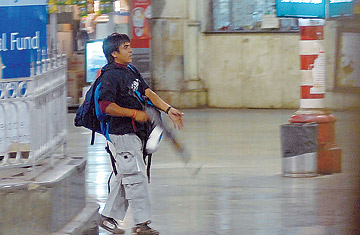
Chhatrapati Shivaji Terminus was the scene of carnage last November after Mohammad Amir Ajmal Qasab, with his partner Ismail Khan, opened fire on commuters.
(4 of 10)
These days, his neighbors have stopped telling stories about Qasab, and journalists are no longer welcome. But before they were excluded from the village, a correspondent from the English-language daily Dawn was able to interview a man who said he was Qasab's father. "I was in denial for the first couple of days, saying to myself it could not have been my son," Amir Qasab told Dawn. "Now I have accepted it." A few years back, said Amir Qasab, he and his son had a quarrel while he was home visiting. "He had asked me for new clothes on 'Id [a religious holiday] that I couldn't provide him. He got angry and left."
A Sort of School
Where that angry scene ends, Qasab's confession seems to pick up. According to the document, Qasab fled his family in 2005 for Ali Hajveri Darbar, a shrine in Lahore dedicated to the memory of a Sufi saint who took Islam to the region through his example of love, charity and direct communication with God. It was a place, Qasab says, where "boys who had run away from their houses are kept." The shrine doesn't have sleeping quarters, says volunteer caretaker Muhammad Soheil, but "many people stay in the nearby area and come here to take our food." Thousands visit the shrine every day, says Soheil, and he has no recollection of Qasab. But, he says, "We believe that if someone comes here with bad intentions, they will become good Muslims."
The evolving strengths of different strains of Islam in South Asia provide an important context for Qasab's tale. In 2007 the Rand Corp. suggested that such groups as Pakistan's Sufi-influenced Barelvi sect--which does not have a jihadist bent--be encouraged in order to combat extremism. But since the anti-Soviet war, Wahhabi groups, drawing their influence from Saudi Arabia's austere brand of Islam--together with the Wahhabis' South Asian counterparts, the Deobandis--have gained ground in Pakistan. Soheil decries the Wahhabi focus on jihad. "Here we teach peace and love in the way of the Prophet," he says. "The problem is that the common people are not literate, so when the cleric says they will go to heaven if they do suicide bombs, they become entrapped and believe him."
For whatever reason, life at the Darbar was not enough for Qasab. He found employment, but after two years, his paltry salary began to rankle him, and he left Lahore to seek his fortune in Rawalpindi.
The LeT office in Rawalpindi directed Qasab to the sprawling campus of the Markaz-al-Dawa wal-Irshad in the town of Muridke, about half an hour's drive from Lahore. Established in 1987 by a trio of veterans from the Afghan jihad with funding from Osama bin Laden, this Wahhabi center quickly became known as the launchpad for militant jihad. But it is much more. Within a few years, the Markaz had expanded to include a madrasah, separate schools for boys and girls, a free hospital and a university. Its founders, Hafiz Saeed, Zafar Iqbal and Abdullah Azzam--the latter was bin Laden's mentor until he was killed by a car bomb in Peshawar in 1989--declared that their objective was to create a model Islamic environment removed from state interference. Education would focus on jihad but also emphasize science and technology. The campus includes stables, fishponds, playing fields, a foundry, a carpentry workshop, a mosque and computer-enabled classrooms. It is better equipped than most Pakistani state universities.