

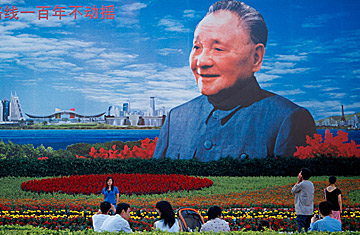
Tourists gather in front of the Deng Xiaoping poster in Shenzhen, China
(7 of 7)
Jiang's biggest problem is that he is only first among equals, and, says Winston Lord, former Assistant Secretary of State for East Asian and Pacific Affairs, "he can't just issue edicts. He has to marshal a consensus." That consigns him to continuity and caution rather than bold decision making in the manner of Deng. One day after the Paramount Leader's death, Jiang issued a statement promising to turn "grief into strength" in "unswerving" pursuit of Deng's policies. The process already in place dictates avoiding radical shifts in economic and political policy at home and minimizing the chances of miscalculation abroad.
China has perhaps become too complex to be run by the old men in Beijing. Unfortunately, Deng left no system of governance to move China from the rule of men to the rule of laws. The country's government is based not on a constitution but on a fluid dynamism where power shifts with personalities and personal alliances. While the Chinese people have learned to fear the depredations of megalomaniacs, they are also afraid that their country will fall apart without a demigod at the helm.
The outside world is just as ambivalent. No matter how prepared China was for Deng's passing, there will be new tensions inside the country, and that promises continued tensions between Beijing and Washington. Even with Deng, says a senior State Department official, "it was a difficult relationship to manage. The prickliness on the Chinese side won't change." U.S. analysts think Jiang is unlikely to advance into greater intimacy with the U.S., yet economic progress depends on keeping the relationship active and friendly.
Jiang has been sending warmer signals to the White House for several months and has been answered in kind, but none of the issues that breed conflict--human-rights abuse, nuclear proliferation, trade barriers, Hong Kong, Taiwan--have been settled. American intelligence agencies view the future darkly and has advised the White House that Jiang's coalition may be only a brief transition before a stronger leader takes power. Says an American intelligence official: "This is a leadership that exhibits a good mixture of hubris and insecurity."
Not surprisingly, the rest of the world reacts in schizophrenic ways to such contradictory impulses. The U.S. has lurched back and forth between accommodating China to gain commercial advantages and condemning its ugly record on human rights and its erratic behavior toward its neighbors. Its repressive treatment of dissent ignites America's cold war instincts. Beijing has not fully resolved what role it wants to play in the world, and that has made it harder for other nations to judge it fairly.
In almost direct proportion, China's confusion about itself leads to confused treatment by other nations. Not only for those inside the country, but for the U.S. and the rest of the outside world, the topography of the next China remains a very troubling question mark.
--Reported by Sandra Burton/Hong Kong, Dean Fischer and Douglas Waller/Washington and Jaime A. FlorCruz/Beijing