

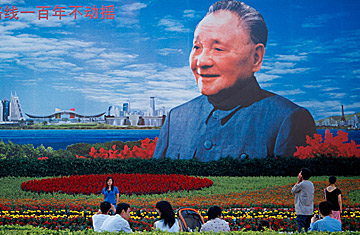
Tourists gather in front of the Deng Xiaoping poster in Shenzhen, China
(5 of 7)
A true market economy cannot emerge fully until the government does something about its ailing state enterprises. These decrepit firms, employing some 100 million workers, are swamped by debt, surplus labor and bloated inventories. Their out-of-date equipment and Marxist management, corrupt and incompetent, make them hopelessly uncompetitive. Half the 100,000 enterprises operate at a loss, and one-third barely turn a profit. At one time or another, half of all state employees have been furloughed or have had their pay or hours cut. Workers earn most of their income moonlighting for private firms.
Yet no one in Beijing has dared face the high-risk social and political consequences of cutting off the subsidies that keep these plants working. Instead Beijing has been pumping billions of dollars into them to stave off their bankruptcy. Shutting down the biggest, most inefficient, monopolistic enterprises would throw millions out of work. Already, wildcat strikes and noisy demonstrations have disrupted several regions.
Corruption is biting into everyone's purse as petty officials, communist bureaucrats, soldiers and policemen, middlemen and hucksters greedily siphon off anything they can stuff into their own pockets. The protests that rocked the communist government in 1989 were in part fueled by popular resentment of endemic financial chicanery. Today the failure to establish political or judicial systems that can check corruption is stirring widespread public anger once again.
Meanwhile, the military is demanding a bigger share of the nation's resources. Tens of thousands of officers and hundreds of thousands of soldiers are busily engaged in the pursuit of commercial interests from chicken farms to karaoke bars as part of an almost comical program of self-financing, but the top brass is not joking about its determination to modernize.
Deng always put revamping the armed forces last among his Four Modernizations, and he demobilized more than a million soldiers from the People's Liberation Army. But the 2.9 million left still operate more like a force trained to envelop an enemy with sheer numbers than one capable of responding rapidly with 21st century firepower. After watching a whole new way of warfare in the Persian Gulf, senior officers went on a buying spree. They came home last year with 50 Russian attack jets, two Russian destroyers, four diesel submarines and 70 fighter planes.
The idea is to convert the defensive People's Army into a modern, mobile attack force capable of projecting power beyond China's borders. Top priority is a blue-water navy to carry troops into areas remote from the mainland. But the Pentagon estimates that it will be at least 20 years before China can rival the U.S. Navy, and it is an open question whether any regime can bear the expense of seeking military superpower status.
"SOCIALISM WITH CHINESE CHARACTERISTICS"