

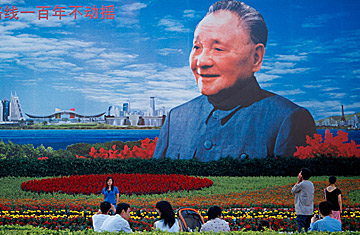
Tourists gather in front of the Deng Xiaoping poster in Shenzhen, China
(6 of 7)
Deng used that maxim to mean many things, but at its most fundamental it defines the base line of his blueprint for reform: a stubborn, inflexible resistance to political change. A hard-liner all his life, he was determined that economic liberalization would not sweep away the Communist Party's monopoly on power. He committed his successors to the relentless repression of democracy. Deng and some of the men now in power ordered the tanks into Tiananmen Square in June 1989 to crush the nascent democracy movement beneath a heap of bloody bodies. Since then, virtually all of China's political dissidents have been jailed or hounded into exile.
The prime ambition of the new leaders is simple: stability. They are not alone in that desire. However cynical the Chinese people have become about Marxism, they, like the leadership, profoundly fear disorder. The terrible decades under Mao taught the entire nation the very real dangers of anarchy, and while the Chinese now want to concentrate on private concerns, they want to do so amid political stability and public order. That allows the regime to maintain a degree of authoritarianism quite abhorrent to Westerners. Jiang and his cohort can probably maintain Deng's dual system of economic progress and political rigidity as long as people's material expectations are being met.
Yet the odds against achieving full modernization without losing political control are daunting. The party's one remaining claim to legitimacy rests on its ability to deliver sustained economic growth and rising incomes. Once people are rich and fat enough, they begin to demand a say in their own governance. What no one can predict is how long China can continue to achieve economic advances without modifying--or being forced to modify--its repressive political system.
One critical indicator to watch is any "reversal of verdicts" on the Tiananmen Square massacre. Ever since that debacle, the regime has declared it the justified suppression of a counterrevolutionary riot by a bunch of hooligans. As long as Deng was alive, no official revisions were possible. But many wonder whether the new leadership will make a bow to all those pressing for political liberalization by changes in the official attitude toward that traumatizing event.
"IT DOESN'T MATTER WHETHER A CAT IS BLACK OR WHITE, AS LONG AS IT CATCHES MICE"
Deng's famous proclamation is usually interpreted as a defense of pragmatism. But it can just as easily be applied to his idea of leadership: not a cult of personality but a test of efficiency. The bottom-line challenge for his chosen heir, Jiang Zemin, is to prove he can carry on Deng's pragmatic work.
Up until Deng's passing, Jiang & Co. had been able to wrap themselves in the mantle of the great man's authority. Now Jiang must cement his own claim to it, and many wonder if he has the strength and charisma to sustain a cohesive leadership or the moral and political pre-eminence to dominate his rivals and his country. He has shown growing self-confidence and has managed to consolidate his base more successfully than anticipated; he is unlikely to be challenged right away as party or national boss.