

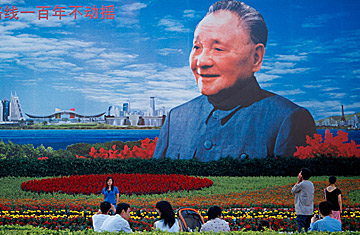
Tourists gather in front of the Deng Xiaoping poster in Shenzhen, China
(4 of 7)
There is even the beginning of grass-roots democracy. With little fanfare or publicity, peasants in villages across China are choosing local leaders by secret ballot from a slate of candidates that may include not only Communist Party members but also individuals with no affiliation. The farmers can unseat the bums who mismanaged the local electrification project or the crooks who pocketed irrigation fees and elect the "capable people" of their choice. By 2000, all of China's more than 1 million villages will operate under the system. Some say these local elections are diluting the Communist Party's power. And the party leaders now have a vested interest in the economy's steady advance. As their Marxist ideology loses all legitimacy under the wave of money that has finally turned the country, after 150 years of sullen resentment, into a strong competitor with the West, their very survival seems to ride on their ability to keep the economy going.
"REFORM MUST BE INSISTED ON FOR 100 YEARS"
China before Deng may have been poor, but everyone was equally in need. Now, around the corner from Shanghai's glittering Golden Age club, those forgotten by the economic boom gather under the eaves of the central railway station. There, a "floating population" of the destitute from far-flung corners of the nation arrives by the carload, hoping that Shanghai will be the land of plenty. Ran Yigang, a scruffy 23-year-old with the thick hands of a farm laborer, got off the train last week from Anhui, one of the poorest provinces. All day he searched in vain for construction work, then collapsed on a bag of clothing in front of the station. He considered whether to take a room for $2.50, a price he considers usurious, or hop a train in search of work elsewhere. "I wonder how people here get so rich," he says.
Deng's commercial revolution is dangerously incomplete. "China is like a movie set," says Mineo Nakajima, one of Japan's leading Sinologists. "It looks wonderful, but it's all an illusion." Many of the most difficult issues were put on hold while Deng lived, but the new regime cannot hope to ignore these malignancies indefinitely.
Even though 800 million peasants were the first to thrive on economic reform, the urban boom has left many of them far behind. Per capita income in the countryside is only $190 a year, about 40% of the urban average. Some 65 million struggle to survive on incomes below the official poverty line of $64 a year. The hinterland clamors for a bigger share of the pie, and historically, rural poverty has been the underlying cause of political unrest. The floating population of desperate job seekers pouring into China's cities has reached 100 million. While they provide the cities with cheap labor, they have stripped the countryside of its ablest workers and are blamed for the wave of crime that plagues urban neighborhoods.
As the gap between rich and poor individuals yawns, so does the divide between wealthy and impoverished provinces, creating competing regional principalities that threaten the control of the central government in Beijing. The wealthy Meccas on the coast routinely ignore orders from the national authorities, their aggressive technocrats think and act according to their own rules, and power flows where the money goes.