

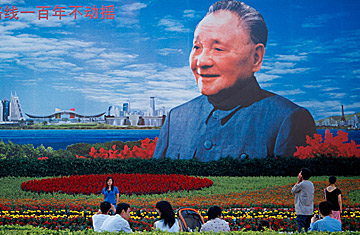
Tourists gather in front of the Deng Xiaoping poster in Shenzhen, China
(2 of 7)
Jiang finds himself thrust into the limelight in what already promises to be a watershed year in Chinese affairs. U.S. Secretary of State Madeleine Albright will pay her maiden call at his office this week. Despite the official six-day period of mourning, Beijing quickly cabled Albright that they wished the meeting to go ahead. "They want to take her measure, and they want to show that it's business as usual," says a senior State Department official. Vice President Al Gore is expected in March. The national parliament opens its annual session that month, and the 15th Party Congress, the important meeting held every five years to fix policy and confirm leadership positions, is scheduled for the fall. Trickiest of all, Hong Kong reverts to Chinese control on July 1 and will be the world's litmus test of China's behavior. How Jiang handles this rush of events will be weighed by every domestic political rival, Chinese citizen and foreign power as a measure of his suitability.
"TO GET RICH IS GLORIOUS"
China, Deng told President Jimmy Carter in 1979, would need a long period of peace to realize its full modernization. To accomplish that, he added, China would also need Western money and know-how. Flinging open the doors, he led China on a capitalist drive from which there is no turning back.
As recently as 1994, Gao Feng, now 47, earned $100 a month as a machine repairman in a state-run textile factory in Shanghai. Then the nearly bankrupt firm laid off 300 workers, promising Gao 300 yuan a month to stay home. "These changes offered new opportunities," says Gao, and so he cobbled together $1,100 and enrolled in a course for taxi drivers. Gao now drives a shiny Santana cab for another state enterprise, and his take-home pay is pegged to his own moxie. On average, he says, he earns $240 a month plying his route from 5:30 a.m. to 9 p.m.
All Shanghai is caught up in entrepreneurial energy. In the mid-'80s, while southern provinces like Guangdong and Hainan turned Deng's experiment in "special zones" into a capitalist boom, Shanghai's decrepit state industries stagnated, its infrastructure disintegrated, and its people sulked. The economic revolution wasn't reaching far beyond a few chosen cities. Recalls Li Bo, a Shanghai economist who runs a consulting firm for German companies: "The most popular expression in 1991 was 'Gao bu hao le'--everything's hopeless."
Everything changed in 1992. Deng emerged from retirement to exhort his successors and lagging Chinese cities to "dive into the sea" of capitalist commerce. Shanghai dived in, reviving all its old spunk and luster. The metropolis is furiously rebuilding, attracting foreign investment, remaking itself into an Asian hub of finance, trade and culture. Officials say they will quadruple the city's industrial and agricultural output by the year 2000.
Today Shanghai is one vast construction site. More than 20,000 projects, including 5,000 major ones, are under way as 27,000 companies build bridges, tunnels, flyovers, ring roads, hotels, villas, golf courses and public housing. The "crane," quips Vice Mayor Zhao Qizheng, should be designated the city's official bird.