

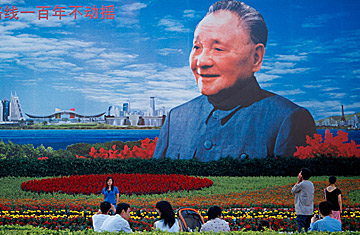
Tourists gather in front of the Deng Xiaoping poster in Shenzhen, China
He was a surprisingly unassuming man for such a titan among statesmen. His round, cherubic face belied a will of steel that had launched his vast land on the most remarkable transformation of the modern age. When death came to Deng Xiaoping last week, at 92, he was nearly blind, deaf, virtually invisible and the honorary chairman of only the China Bridge Association. Yet even in his long political twilight, he still cast a shadow over the nation, at once reassuring and restricting the Chinese as they march uncertainly toward the 21st century.
The seismic changes Deng set in motion were daring, thrusting one-fifth of mankind in a Great Leap Outward from the crushing, dogmatic isolation of Maoism into a quasi-capitalist economic miracle. The China that comes after Deng will grow inexorably from the complex of roots he planted firmly in the nation's soil. Yet his work is unfinished, and the next China will have to come to terms with the fundamental contradiction in his hybrid creation. Even as the country embarked on a headlong pursuit of free-market economics, Deng insisted it be done under the iron fist of a rigid communist political system. The people would be free to get rich but not to challenge or change their leaders. Economic liberties would have to coexist with political bondage. China would continue to be ruled by men, not laws.
When this frail old man finally succumbed to the Parkinson's disease and lung ailments that had sparked rumors of his demise for years, most Chinese registered barely a sigh. Black-clad television announcers proclaimed his death just a few hours after it occurred, while traffic continued to thread through Tiananmen Square. The casual manner in which Beijing residents went about their daily routines offered eloquent proof that the Chinese have accepted their leader's mortality and long since discounted his loss. "We are at ease with the thought that things will be all right without Deng," said Beijing writer Yin Zhixian. "It's unlikely that there will be major changes, because everyone is a beneficiary of Deng's policies." Thirtyish Zhu Xun, manager of the Shanghai office of a German air-conditioning firm, raised his glass of white wine at the chic Golden Age club in a fitting toast: "Thank you, Comrade Deng."
Though he continued to wield an almost mystic influence from his private Beijing compound, Deng's gradual withdrawal from overt power allowed his successors to prepare for an orderly transition. He was, like the ghosts Chinese revere, a force the current leaders dared not speak of disrespectfully. The steady rise in personal prosperity has persuaded China's citizens that their new leaders will continue to follow in Deng's footsteps without a major change of direction.
Yet for all their outward calm, the Chinese are as anxious as the rest of the world about their future. Jiang Zemin, State President, head of the party, chief of the military committee, the "core" of the new collective leadership, was ordained by Deng eight years ago and has been running the government pretty much ever since. But history has never been kind to China in its moments of transition from one ruler to the next. And though there is confidence that these new leaders are firmly set upon the path of reform, there is equal doubt that they have the courage, stamina and leadership to complete the journey.