

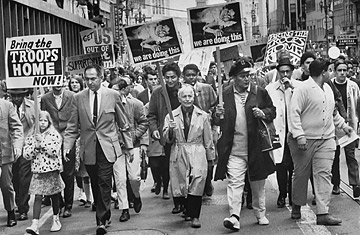
Vietnam War protesters carrying antiwar signs march in San Francisco from Market Street to Golden Gate Park's Kezar Stadium for a rally called Spring Mobilization to End the War in Vietnam
(7 of 7)
There are some other questions to be asked, in due course, about the quality of the U.S. military strategy and performance in Viet Nam. We are up against the most experienced guerrilla fighters in the world, but we tried to force much of the South Vietnamese military effort into conventional U.S. military forms. The whole Kennedy-McNamara-Johnson doctrine of slowly stepping up the levels of force was a failure. The enemy was always able to adapt and respond. The fantastic complexity of the U.S. command structure, the mystifying extra layer at Pearl Harbor, the tremendous logistical and bureaucratic component in our forces in Viet Nam —all of these deserve rigorous review. So do the American doctrines of airpower.
∙
There is one large lesson not to be drawn from Viet Nam. Some cynic has said that Viet Nam has given war a bad name, and it sometimes seems as though Viet Nam has also given foreign policy a bad name. Thomas Hughes, the new president of the Carnegie Endowment for International Peace, deplores "the flight from foreign policy." Surely it would be the greatest of all tragedies of Viet Nam if it so soured or embittered us that we tried to draw back in on ourselves. The U.S. cannot escape the consequences of American power even if it wanted to, but just to try could be costly and dangerous.
President Nixon obviously remains a world-minded man. He is pursuing some very skillful diplomacy, both patient and imaginative, in regard to the Middle East, China and the Soviet Union. He was proud last month (and rightly so) to be able to announce the possibility of an anti-ballistic missile agreement with the Russians, and he is plainly pleased and intrigued by the opening in our relations with China. And this brings us to the final irony of our Viet Nam War, now in its seventh year. We first became involved in Viet Nam to contain China, and our contain-China policy first developed in the days when China and Russia seemed to be a monolithic Communist bloc. If it is now safe for us to trade with China and safe to negotiate an ABM agreement with Russia, it should be safe, at last, to bring our soldiers home from Viet Nam.