

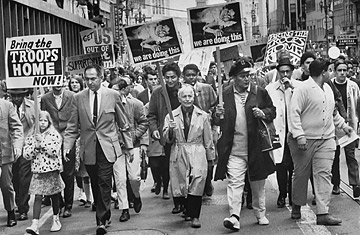
Vietnam War protesters carrying antiwar signs march in San Francisco from Market Street to Golden Gate Park's Kezar Stadium for a rally called Spring Mobilization to End the War in Vietnam
COMING TO TERMS
The following Essay by Hedley Donovan, the editor-in-chief of Time Inc., is based on a speech he delivered in Chicago last month at the annual FORTUNE dinner for executives of the 500 largest U.S. corporations:
THERE are still important choices to be made about Viet Nam. The U.S. is halfway out of the war, and the further troop withdrawals that the President has announced will see us two-thirds of the way out by the end of this year. But it is still far from clear just how we are going to come the rest of the way out. Can we come all the way out? When? And do we come out in ways that make it possible to live with the result?
There are also choices to be made regarding how Americans think about what they have been through in Viet Nam. These are choices that could be quite critical for the future of the country for a good many years to come. There are things that we as a nation can reasonably ask the President and Congress to do, or stop doing, now.
∙
We must all begin by recapturing some sense of astonishment that the U.S. is still engaged in this war. Very few people can say any longer just when the U.S. did begin fighting in Viet Nam. It could be dated all the way back to the death of the first American soldier there in 1961; in the next year or two, about 250 Americans were killed while serving as military advisers. There are college seniors graduating this week who, if they began paying some attention to the news when they were, say, 14 years old, have never known a time when the U.S. was not fighting in Viet Nam.
The major intervention began on Feb. 7, 1965, with the first U.S. bombing of the North, followed in early March by the first U.S. ground-combat units going ashore near Danang. Surely nobody then in the White House, the Pentagon or Congress could have imagined that the commitment would grow to more than half a million men and the cost, at its peak, to nearly $30 billion a year; that more than six years later there would still be a quarter of a million Americans there; that in the first week of June 1971 the total of American dead would increase from 45,183 to 45,231. Richard Nixon could not have foreseen this when, while campaigning in New Hampshire in March 1968, he said, "It is essential that we end this war, and end it quickly." That was more than three years ago and, as matters have turned out, the U.S. was then less than halfway through the war. We must try to stay astonished by this. President Nixon, in his present statements about Viet Nam, ought to put more stress on the sheer staggering length of the war, because so much else flows from that.
∙