

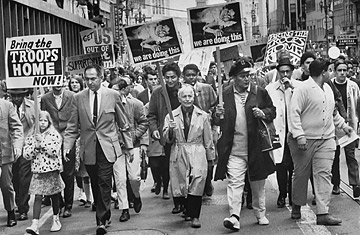
Vietnam War protesters carrying antiwar signs march in San Francisco from Market Street to Golden Gate Park's Kezar Stadium for a rally called Spring Mobilization to End the War in Vietnam
(2 of 7)
About a year ago, an editorial in LIFE advocated a fixed date for total withdrawal of U.S. forces from Viet Nam; the end of 1971, then 18 months away, was proposed. That date has now drawn too close to be practical, but a deadline of April 1, 1972, or July 1, could be met. This is not too different, of course, from what may be inferred from various statements by the President and members of his Administration, which suggest that virtually all U.S. ground troops will be out some time in the second half of 1972. So far, however, the President stoutly refuses to commit himself publicly to a final date or to specify what residual forces might be left behind. The impression—but it cannot be pinned down—is that the U.S. ground-combat role will end late this year, but that U.S. air-combat operations and logistical support could continue a year or two longer, with up to 100,000 Americans still involved in Southeast Asia. The President's desire to hold back one or two cards for bargaining vis-à-vis North Viet Nam is understandable, but no longer worth what it costs in the U.S. or in South Viet Nam.
In South Viet Nam there are important elections coming up—in August for the Lower House of the National Assembly, in October for the presidency (see THE WORLD). The South Vietnamese candidates and voters are entitled to a clear understanding of what is now quite fuzzy: the limitations on the future U.S. role in South Viet Nam. There begins to be a good deal of evidence that the South Vietnamese do more on their own behalf when the U.S. does less. For better or worse, however, they should now have to plan on the Americans being gone, instead of assuming, because U.S. leaders never quite say otherwise, that our presence can always be prolonged. It would be good to get this out in the open before the South Vietnamese elections; to postpone the news is to export a bit of our own credibility gap.
∙
Senator Adlai Stevenson III of Illinois has proposed that a commission from the Congress go to Viet Nam to make sure that the American Embassy is neutral in the coming elections. This would surely be seen as a sign that the Congress was neutral against President Thieu. His regime has severe corruption problems, and he has thrown some of his most prominent political opponents, not necessarily Communists, into jail. But his government is fairly effective and has shown remarkable staying power. It is not up to the U.S. to try to "dump" Thieu.
There is an election coming up in the U.S. too. As between President Nixon and the various Democratic candidates and warmers-up, it is hard to say who would be helped and who hurt by a clear presidential commitment this summer that we will be out by next summer. But the U.S. would be helped in many ways by having such a resolve finally understood, and the general quality of next year's presidential campaign would certainly be improved. We would give both Viet Nams, North and South, far less opportunity to interfere in our election.