

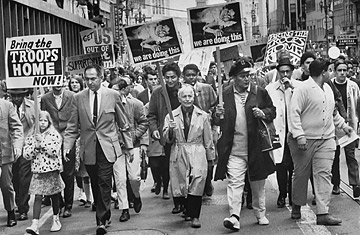
Vietnam War protesters carrying antiwar signs march in San Francisco from Market Street to Golden Gate Park's Kezar Stadium for a rally called Spring Mobilization to End the War in Vietnam
(4 of 7)
We are not talking here about deserting an ally, and we are certainly not talking about the defeat of the U.S. We are discussing one specific and important failure: despite a tremendous effort, we were not able to project American power into a very complicated little country 8,000 miles from San Diego in such a way that a non-Communist government was certain to prevail. We are having to settle for a possibility that it will prevail.
Was our mistake to try at all? Or was it the way we went about it? For my own part, I happen still to think that the U.S. was right to try in 1965 to prevent the forcible takeover of South Viet Nam by Communism, and that such a takeover would have happened if we had not moved in as we did. I would say now, though I did not see it then, that we went on in 1966 and 1967 to expand the U.S. effort far out of proportion to our original purposes, and that this enlarged commitment then began to take on a life of its own and even to work against our original purposes. It took me the better part of those two years to begin to see that. I wish I had been wiser sooner.
I mention my own record not because it is important in itself but to suggest a kind of Viet Nam autobiography that many of us carry around, whether we like it or not. Government officials, journalists, academics, business executives, clergymen, student leaders, military men—all the Americans who have spoken out about Viet Nam need some perspective today on their own earlier views. Some will conclude that they were right all along, and perhaps some were. But if the country is to come to terms with the Viet Nam experience, the process must begin with a good many individuals studying and acknowledging their own errors.
Such a process could help arrest any wave of national bitterness and recrimination. The President should do more to prepare the public for an ambiguous or even painful outcome in Viet Nam. This would be good immunization against the "right-wing backlash" that the White House professes to fear.
∙
There are those who worry about a new "stab in the back" legend—an American equivalent of the Nazi notion that the German army really was winning World War I but was betrayed by the softness of the home front. But it would be surprising if such an unpopular war as Viet Nam, in such a cloudy cause, could spawn similar postwar legends. It would take an absolutely brilliant demagogue to get much mileage from the question: Who lost Viet Nam?