

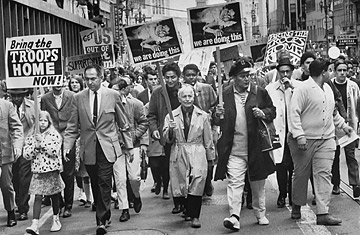
Vietnam War protesters carrying antiwar signs march in San Francisco from Market Street to Golden Gate Park's Kezar Stadium for a rally called Spring Mobilization to End the War in Vietnam
(6 of 7)
It is very difficult—practically impossible, fortunately—to visualize another place in the world where another Viet Nam could develop, where conditions of enough complexity could sustain such a baffling and inconclusive war over so many years. But it is not impossible to imagine other local and limited wars with American involvement. The warmaking responsibility should be shared by the President and the Congress, not only because the founding fathers so clearly intended it but because this is a decision that needs the benefit of collective wisdom and collective accountability. And if the decision is for war, then the war will be better understood and better prosecuted.
The Executive Branch of the Government urgently needs some possibility somehow of being wrong. That is, it needs arrangements that would allow men to change their minds. In March of 1968, Lyndon Johnson finally came to a momentous shift in Viet Nam policy: the decision to level off U.S. troop strength, to stop bombing the North, to pursue negotiating possibilities more actively. In short, the beginning of deescalation. But it had taken the enemy's Tet offensive of January and February, Senator Eugene McCarthy's stunning showing in the New Hampshire primary in March, and the entrance of Robert Kennedy into the presidential campaign to bring about this policy shift.
We keep learning of important figures in the Johnson Administration who are now said to have been increasingly skeptical about the Viet Nam policy in 1966 and 1967. In those years the President and his men apparently found no way to stand at a distance and periodically re-examine Viet Nam policy with open minds. It is conceivable that some day we will learn of men within the present Administration who in 1970 and 1971 also had the feeling that there was no way to break free of vested interest in past error. The question is whether there is some political mechanism that can operate in between presidential-election years to provide a tough internal review of Executive policy.
If Richard Nixon is reelected, he might tackle this question in his second term. He has shown a very strong interest in the —organization of the presidency and the flow of work and responsibility within the Executive Branch. Some of his critics treat this as a trivial preoccupation with mechanics, but that is a quite mistaken view. Management instruments, in government as well as corporate life, can have highly creative consequences.
Still within the Executive Branch, there are important questions to be asked about the effectiveness of our intelligence operations and our ability to draw policy conclusions from intelligence information. It is extraordinary how often our side was wrong about what the North Vietnamese and Viet Cong could and would do. We have consistently underestimated their military capability—especially their ability to adjust to our moves—and we have overestimated their interest in negotiating. We possess tons of captured enemy documents. We have interrogated thousands of prisoners and flown thousands of reconnaissance sorties. Our South Vietnamese allies presumably have agents on the ground in North Viet Nam. Yet the enemy has repeatedly surprised us.