

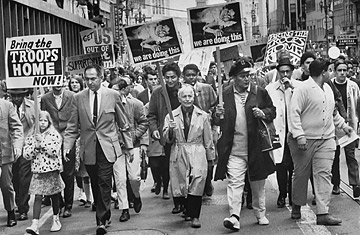
Vietnam War protesters carrying antiwar signs march in San Francisco from Market Street to Golden Gate Park's Kezar Stadium for a rally called Spring Mobilization to End the War in Vietnam
(3 of 7)
Coming out of Viet Nam means removing all American combat and support forces—land, sea and air—from South Viet Nam, and ending air operations, carrier-based or Thailand-based, over Viet Nam, Laos, Cambodia. The U.S. should continue supplying military equipment to South Viet Nam, as it does to twelve other countries, and could maintain a small military advisory group there, perhaps a few thousand men. It is true that this leaves the North Vietnamese with no need to negotiate to get us out. Over the years, however, they have shown very little interest in negotiating no matter what we did, whether we bombed them, stopped bombing, put troops in, took troops out.
The U.S. must regain control of its own policy. Many thoughtful Americans are honestly doubtful that a non-Communist South can survive after we go, and at least a few Americans will apparently be disappointed if it does. Actually, there are grounds for thinking that the South has a fighting chance, but it is also clear that the U.S. can no longer stay indefinitely to protect or improve that chance. It really is up to the Vietnamese.
∙
Way back in 1966, Republican Senator George Aiken of Vermont suggested that the U.S. should claim victory and come home. We may well have accomplished more in South Viet Nam than in our present mood we give ourselves credit for. The point is, we have now done what we could. President Nixon should stress more often that America has made an enormous effort, far beyond anything that could have been considered a diplomatic or moral contract with South Viet Nam. He should also emphasize America's willingness to contribute generously to the postwar economic development of Viet Nam, North as well as South, and all of battered Indochina. Nixon, and President Johnson before him, have been strangely reluctant to make this a major theme. We do not need to flagellate ourselves—as various church groups, student organizations and so on have suggested—by calling such aid "reparations." But economic assistance surely is a duty as well as an opportunity to give an affirmative cast to U.S. policy in Southeast Asia.
There are particular people who should be very much on our minds and consciences. We owe special honor and comfort to the families of the Americans who gave their lives in Viet Nam, and we owe a special scorn to any politicians who might seek to exploit their sorrow. We owe far better medical care to the Viet Nam wounded than they are getting in many of our hospitals. We must, of course, bring home our prisoners from North Viet Nam, though it may not help to treat this as a condition for, instead of a consequence of, peace. We may need to prepare some kind of asylum opportunities for individual South Vietnamese who may feel that they have to leave when the last American troops leave. Meanwhile, it is reckless for American officials to raise the specter of a bloodbath. That could be an argument for staying in Viet Nam forever.