

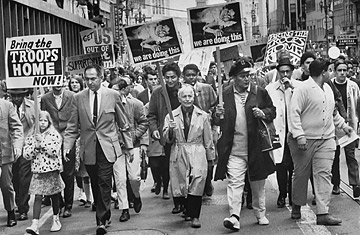
Vietnam War protesters carrying antiwar signs march in San Francisco from Market Street to Golden Gate Park's Kezar Stadium for a rally called Spring Mobilization to End the War in Vietnam
(5 of 7)
There was a left-wing rumor that had a few days of life earlier this spring. A story was printed about stupendous petroleum possibilities in the waters off South Viet Nam. One could almost hear a great cry of "Aha!" rise up from all those people who have known all along that the Viet Nam War must be a plot of American capitalists. The great oil bonanza was soon deflated; among other things, a wire service had made a mistake in a figure, and 4,000,000 bbl. had become 400 million. Except to the farthest-out, craziest left, U.S. business really is not a satisfactory Viet Nam villain; it is not easy to name many American corporations that have been getting much good out of the war, and it is easy to show that corporate profits and the whole economy have been hurt. The sophisticated Marxist comment about U.S. business and Viet Nam would perhaps be that the ruling class is not always bright.
Our Viet Nam policy was not the work of any lobby. It has not been deeply influenced by Republican or Democratic partisanship and certainly has not been a vehicle for individual career ism. It has been quite "pure" executive policy, conceived and carried out by honorable and able men; indeed, some very brilliant men have had a hand in it. Yet in many respects it has been badly bungled under three Presidents of two parties.
One of the ways a stable individual recovers from a frustrating or wounding experience is by telling himself that at least he learned something from it. As a nation there is plenty we might learn from Viet Nam.
One lesson, surely, is that Viet Nam has been and still is too much a President's war, first Johnson's and now Nixon's. A democracy does not fight at its best that way. Senator John Stennis of Mississippi, chairman of the Armed Services Committee, has proposed legislation that would not apply to Viet Nam but thereafter: permitting the President to send troops into battle without a declaration of war only to repel an attack against the U.S. or to protect Americans abroad. These troops would have to be withdrawn within 30 days unless Congress approved the action. Senator Jacob Javits of New York had already put forth a similar bill. Some such legislation is very much in the national interest. There is no question that the President needs sweeping powers to deal with one of those 15-minute thermonuclear decisions that he, and we, pray that he will never have to face. But Viet Nam has been about as far from the midnight showdown as anything that could be invented: each major decision in the whole long, agonizing process has been studied for days, weeks, sometimes months, within the Executive Branch. There would have been plenty of time for full collaboration with Congress at every step of the way.
∙