

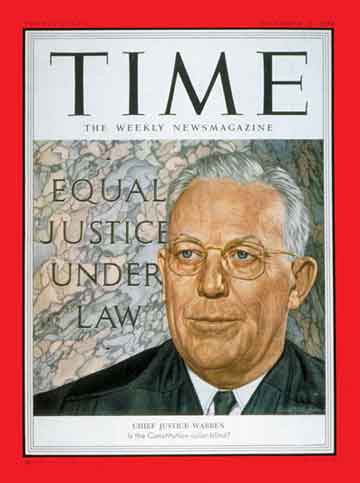
Chief Justice Earl Warren
(3 of 8)
The Negro children's attempt to enter Sousa Junior High School was a maneuver carefully planned by the Consolidated Parent Group, an organization of Negro parents headed by a barbershop owner who once paid a $10 fine for taking his three-year-old daughter into a white playground in Washington. The other four cases before the court, from South Carolina, Virginia, Delaware and Kansas, were brought about in much the same manner by the N.A.A.C.P. The legal technicalities in the lawsuits differ somewhat from case to case,* but the aim is the same: mixed schools.
Two Men & a Cause. The issue that brought the name of Spottswood Boiling before the U.S. Supreme Court is in no sense new. Where and how the Negro should be educated has been in dispute in the U.S. ever since Thomas Jefferson wrote that "all men are created equal." Before the Civil War, teaching a slave to read was a crime punishable by imprisonment in some Southern states. But after the war, there was a crusade to raise the freed slave's status. It was led by two white men: Thaddeus Stevens of Pennsylvania and Charles Sumner of Massachusetts.
Stevens, a stony-faced, crippled son of a Vermont village shoemaker, was the crude but effective pleader for the Negro in the U.S. House of Representatives. Sumner, a master orator who succeeded Daniel Webster in the U.S. Senate, carried the Negro's banner there. They were the spiritual leaders of the "Radical Republicans," whose pro-Negro stand was far beyond that of Abraham Lincoln. In 1866, when President Andrew Johnson vetoed a bill to expand the Freedmen's Bureau (an agency to aid and educate former slaves), Stevens rose in the House and called the North Carolina-born President "an alien enemy, a citizen of a foreign state." In the Senate, Sumner cried that Johnson was "an insolent, drunken brute, in comparison with which Caligula's horse† was respectable."
Fighting for their cause with such vehemence, Sumner and Stevens pushed the 14th Amendment to the Constitution, passed in 1866, providing that "no state shall make or enforce any law which shall abridge the privileges or immunities of citizens." They rammed through the reconstruction acts of 1867, which established military governors over ten Southern states and set the terms on which the states would be readmitted to the Union. Among their terms: suffrage for Negroes and ratification of the 14th Amendment.
What Kind of Equality? The Negro's status rose dramatically. But the rise stopped suddenly in 1877, largely as the result of politics. The electoral votes in the election of November 1876 were so close and the charges of fraud so numerous that the election was thrown into Congress. Republican leaders knew that the doubtful votes of South Carolina, Florida and Louisiana would elect Republican Rutherford B. Hayes over Democrat Samuel Tilden. Spokesmen for the G.O.P. and for Southern Democrats met and made an agreement. The Southern states would throw their electoral votes to Hayes, and his Administration would grant concessions to the South. Among those concessions : 1) troops would be withdrawn, and 2) the states would be permitted to establish their own policies toward the Negro. Hayes got just enough (185) electoral votes. The troops were withdrawn.