

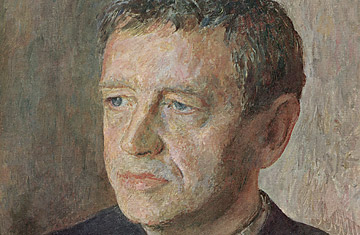
Portrait of the artist Andrew Wyeth done by his sister, Henriette Hurd.
(9 of 9)
The Young American is only a boy that Wyeth knows, not a totem conjured up from American mythology. He proves that the microcosm of Chadds Ford and Cushing is not so intimate a topography that the whole world cannot be gleaned from it. As Gertrude Stein wrote, "Anybody is as their land and air is," and Wyeth's land and air happen to be everybody's. It is a visible metaphor of any world for any man.
* Others that have temperas: Milwaukee Art Center; Wilmington (Del.) Society of the Fine Arts; Addison Gallery of American Art in Andover, Mass.; Toledo Museum of Art; Philadelphia Museum of Art; Pennsylvania Academy of the Fine Arts in Philadelphia; William A. Farnsworth Library and Art Museum in Rockland, Me.; Shelburne (Vt.) Museum; New Britain (Conn.) Museum of American Art; Wadsworth Atheneum in Hartford, Conn.; and Currier Gallery of Art in Manchester, N.H. * Drybrush, used by Wyeth's mentor of the miniature, Albrecht Dürer, as early as 1450, is more like drawing than watercoloring in technique. The artist works over still wet washes of water-soluble pigment with a brush dipped in concentrated color and squeezed almost dry. The stiff bristles, flattened and frayed looking, add textures of weight and depth. "I use it for the grass on a hill, for example, or the bark of a tree," says Wyeth. * The National Gallery of Norway in Oslo has the 1959 tempera, Albert's Son, by donation from former U.S. Ambassador to Norway L. Corrin Strong.