

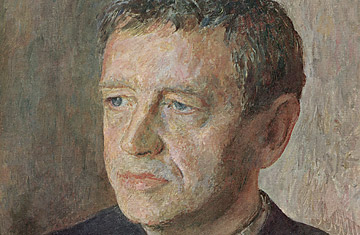
Portrait of the artist Andrew Wyeth done by his sister, Henriette Hurd.
(4 of 9)
"Leaning on the walls and lying all over shelves are sketches that Mr. Wyeth has made. He has sketches in color which make small pieces of the picture. When he sits down to work on the painting he has to fit the pieces together in his mind. The hardest part is just going on and on and on to finish the job after you're over the excitement of suddenly knowing what you want to do and the fast sketches.
"Like anyone else returning from work Mr. Wyeth changes out of his old paint-spattered pants when he gets in the house. When he returns from the studio he always has paint on himself too. One place is really very noticeable —a long streak on his lower lip. That comes from wiping the extra paint off his brush; since his lip is handy, he makes use of it."
A Dynasty of Art. The name Wyeth is familiar to almost every kid who ever had a library card, because it belongs to the most ambitious American art dynasty since the 18th century Philadelphia painter Charles Willson Peale named his children Rembrandt, Rubens, Raphaelle and Titian and brought two of them up to join a raft of relatives in the family trade. The Wyeth dynasty was founded when Newell Converse Wyeth went in 1903 from Massachusetts to Wilmington, Del., to study painting with the scholarly illustrator Howard Pyle. Often Pyle and his favorite pupil would journey the twelve miles out of Wilmington to Chadds Ford to paint along the banks of the Brandywine near the old gristmill. Within three years, N.C. had married, and soon after put down roots in the Pennsylvania hills.
N.C.'s artistic style set the style for his family. Ruddy, with the outdoorsy zest of his Welsh ancestors, he painted robust men of action whose thighs and biceps strained the seams of some of the best-executed costumes in all book illustration. Generations of children know the gnarled tree trunks of Sherwood Forest from his illustrations for Robin Hood, or Blind Pew frantically tapping down the road after his cowardly companions in Treasure Island. Although N.C. wished to be remembered as a muralist, his best-known works bear such romantic titles as "One more step, Mr. Israel Hands, and I'll blow your brains out."
Method Painting. Last of his father's five children, Andrew Wyeth was born into a virtual factory of fantasy. N.C. spouted Shakespeare as he dosed his children with castor oil, encouraged them to set up toy theaters all over the house, and persuaded them well up into their teens that Santa Claus did indeed exist. But his greatest gift was teaching his brood how to re-create drama, and a little art colony sprang up by the Brandywine.
"Never paint the material of the sleeve," N.C. would roar. "Become the arm!" It was classical instruction, demanding empathy with the object. Yet the leonine old illustrator never let his pupils fall for the pathetic fallacy—that empty barrels are lonely. He believed that the painting must find an echo inside the painter—in a sense, Method painting. It was all done with such verve and warmth that, as Sister Carolyn says, "there was nothing arty about it. It was like coasting, like playing outside in the snow."