

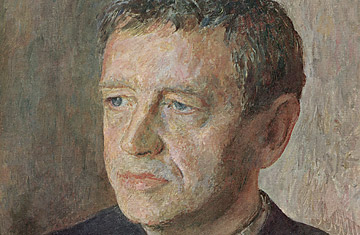
Portrait of the artist Andrew Wyeth done by his sister, Henriette Hurd.
(See Cover)
It was a natural question; under the circumstances, anybody would have asked it. Harvard's President Nathan Pusey, chatting with Painter Andrew Wyeth at dinner the night before giving him an honorary doctor of fine arts degree in 1955, inquired: "And where did you go to college?" Wyeth knew that his answer might well be dumfounding to a professional protagonist of formal learning, but he went ahead and said it: "I didn't go to college. I never even went to school." Recalling Pusey's expression now, Wyeth says: "He almost fainted."
Of course, Wyeth did get an education: in academic matters from tutors, in art from his late renowned father N. C. Wyeth. But if in the scholarly sense he never went to school, in the artistic sense he is his own school.
Andrew Wyeth of Chadds Ford, Pa. (pop. 140), and Cushing, Me. (pop. 130), stands high and apart from the mainstream of American art. Manhattan-centered abstract expressionism has in the past two decades given a multitude of new answers to the central questions: What is painting? What is art? What is form? Wyeth is no heroic rearguard defender against that trend. But, in a tradition going back to Rembrandt and to the roots of art, he insists on exploring something else: the condition of nature and the depth of the human spirit.
He paints landscapes and houses, the outside and inside of the world where man lives. Across these carefully recorded scenes, he shows the track, the flicker, the expression of life, even if the living object has long since departed—the print of a heron on the sand, the feeling that a crow flew by, the sea shells lined up in an empty room on a woman's whim. Millions are touched by these intimations, faint but intense; they are touched in their sense of mortality, and they count Andrew Wyeth an incomparable painter.
His temperas are in major American museums, from Manhattan's Met and Modern to Houston's Museum of Fine Arts.* His shows are thronged: 247,800 people went to a month-long Wyeth show in Buffalo last year. Last summer, when President Kennedy picked a painter to be among the first winners of the Medal of Freedom—the U.S.'s highest civilian honor—it was quite inevitable that the choice would be Wyeth. A fortnight ago, President Johnson presented it to him with a citation declaring that "he has in the great humanist tradition illuminated and clarified the verities" of life.
Youthful Spirit. The one most revealing fact about Andrew Wyeth is his age: 46. His paintings may treat of age-old wisdom; his life speaks of free-spirited youth. He has a classic car, a Mark II Lincoln Continental, drives it with abandon. He drinks endless mugfuls of heady, homemade hard cider.
He loves clowning: one Halloween he festooned his tall gaunt frame with animal hair stuck on with flour paste, and roamed Chadds Ford like a bundle of Hydes. When he dresses up for company, he dons a black Amish-elder's jacket that makes him look like Nehru in mourning.