

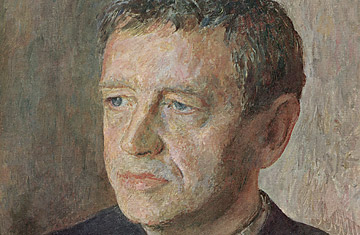
Portrait of the artist Andrew Wyeth done by his sister, Henriette Hurd.
(5 of 9)
The White Company. Quite naturally, the dynasty flourished. The eldest, Henriette, a painter in her own right, is married to Painter Hurd. Most eccentric of the children is Carolyn, now 54, who gallivants about in a flat black Gaucho hat, paints and teaches art classes. Sister Ann, 48, turned to music, but married one of N.C.'s students, John McCoy, and stayed on in Chadds Ford. Brother Nathaniel, 52, "drew neat little pictures inside little squares," married a niece of Howard Pyle, and quite naturally became a creative engineer in research for Du Pont in nearby Wilmington.
As the bouncy benjamin of N.C.'s children, Andy enjoyed a special freedom from responsibility. Two weeks in the first grade of the Chadds Ford school made Andy "nervous," so his father generously took him out and supplied a tutor until he was 16. He grew up like Peter Pan, a prisoner of fantasy. "As a kid," he says, "I adored Robin Hood, D'Artagnan, and"—he adds innocently—"Dracula." N.C. designed an immense castle, which his eldest son, Nat, built for the children's playroom. Andy became its lord and staged jousts within its battlements.
He hoarded the kind of toy soldiers that struck extravagant poses, and left those that stood stiffly at attention to the other children. At the age of nine, Andy did a book of watercolors, full of musketeers and damsels in distress, and romantically titled The Clang of Steel. When he was twelve, Andy staged a memorable performance, Lilliputian-style in a theater that he made himself, of the battle in The White Company, the Arthur Conan Doyle drama of a staunch medieval company of soldiers, which N.C. had illustrated. The old playroom castle still sits in Andy's studio, and the toy soldiers are billeted in a light box in his bedroom. "I've always loved miniature things," he says. "Maybe that's why I turned to the fine technique of tempera."
Andy spent at least two years half believing that he was Robin Hood. In a green hat and a phony blond beard, he romped the woods with Little John, a Negro playmate named David ("Doo-Doo") Lawrence, and a band of merry youngsters. Sometimes they would swoop down on a wealthy noble, such as the grocery boy, and back in the forest they would picnic on robbed riches. Another childhood chum was Vincent T. ("Skootch") Talley, who, before he died this month, recalled that Andy's greatest thrill was a mock re-enactment of the battle of Brandywine. "We had one thing in common," said Skootch. "We never grew up."
"My Father, of Course." The Wyeths always summered in Maine, and there, on his 22nd birthday, Andy met his future wife, who was then only 17. The next year, while he continued to study and paint with his father, they were married. When the war years came, he tried to enlist, but was decisively 4-F'ed because of crooked hip joints, which give him a gangly gait. Instead, at a time when U.S. art was at a virtual standstill, he churned out vigorous, splashy watercolors that explored flattened space, joyous color and jumpy line in such a way that they could have marked him as a nascent abstract expressionist.