

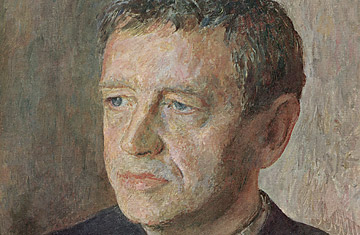
Portrait of the artist Andrew Wyeth done by his sister, Henriette Hurd.
(7 of 9)
Where Now, Brown Cow. Wyeth knows that his work is sometimes admired by the wrong people for the wrong reasons. "Ooooo!" he mocks, "Mr. Wyeth, such a bee-o-o-ooootiful cow!" Says he: "I'm a pure abstractionist in my thought. I'm no more like a realist, such as Eakins or Copley, than I'm like the man in the moon." Wyeth is neither a slave to the faithful detailing of nature, as were Courbet and Manet, nor a scientific observer of light and atmosphere, as were the impressionists. "I want more than half the story," he says. "There are some people who like my work because they see every blade of grass. They're seeing only one side of it. They don't see the tone. If you can combine realism and abstraction, you've got something terrific."
Wyeth frequently does. He "pulls things down to simplicity," excluding from his work the superfluous and the sentimental. He is an expressionist, selecting from his subjective feeling only what is necessary to the painting. In his Brown Swiss, a skyless 1957 landscape titled for the breed of cows crossing it, Wyeth blithely eliminated the cows. Instead, he showed narrow cow paths like the creases of a worried century across the brown brow of a hillside. Nowadays, he feels that he could even have removed Christina from Christina's World and still have conveyed the same sense of loneliness.
The Ever-Subtler Second. From the depiction of high drama as his father taught it, Wyeth has narrowed down to the moments when life is charged with change, swapping N.C.'s clash of cut lasses for his own clap of distant thunder. Sometimes it is only the tragic twinkle of quaker ladies, blossoming while he watches and fading in the frosty dew of early spring. Disciplining the romantic inside him, he has sought the ever-subtler second when existence is galvanized by the unexpected.
"It's got to give me goose pimples," he says. His flesh crawls at odd moments. In Wind from the Sea Wyeth opens an upstairs window in Christina Olson's house in a room that has been closed for years, and the billowing of lace curtains lets in a sudden puff of salty air. Wyeth is moved. Abruptly glimpsing his own reflection in a dusty mirror leads to an unexpected 1949 self-portrait, The Revenant, where he stands perplexed and unbalanced in an abandoned room. The amber glass ball on a lightning rod in Northern Point looks to him "as if it were spinning in mid-air." And after four days of straddling the roof top and examining it with his feverish watercolor brush, Wyeth slowly turned to recapture in tempera that first instant of surprise.
Scratches at the Mask. Wyeth paints a timeless natural world, probing past the facades of nature, where some people only see picnic sites, to a further reality behind. He has sketched countless pencil studies of tiny seed pods as fragilely faceted as snowflakes, made exquisite drybrush watercolors* of bees' honeycombs in winter. Thus he scratches at the mask of nature, attempts by imitation to expose her identity. For Wyeth well knows now one poignant tragedy of man: that he can never know all his world before it vanishes from his sight.