

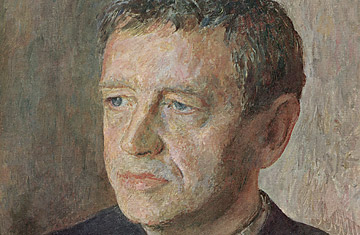
Portrait of the artist Andrew Wyeth done by his sister, Henriette Hurd.
(8 of 9)
This line of investigation makes his New York contemporaries view Wyeth as a country cousin. To Larry Rivers, "He's like someone who writes marvelous sonnets, but I don't read sonnets much." To Jack Levine, he is "a symbol of real, real bedrock Americanismo." Painter Robert Motherwell, formerly an art historian, says: "I would imagine that an impressionist would have looked at the pre-Raphaelites with astonishment, and I feel a parallel astonishment regarding the works of Wyeth." But they all look carefully at what Wyeth does, and agree that there is something uncanny, macabre and mysterious about it.
"Who?" To some, a man who bothers to paint a blade of grass is an anachronism who must have been born in the previous century. The late Bernard Berenson, going on guesswork, believed that Wyeth was dead ("What a pity America has starved its painters," he murmured). No foreign museums or collectors have ever bought his work.*
Few foreigners recognize his existence, although the abstract expressionists are well known abroad, and even the Pop artists have attained some vogue. When Bernard Dorival, director of Paris' Museum of Modern Art, was asked about Wyeth, he replied, "Who? But perhaps we pronounce his name differently here." Wyeth returns the compliment. He has never felt the need to go to Europe—or, for that matter, to much of anywhere else that is very far from Chadds Ford or Cushing.
Wyeth feels that if he wants to find exotic things, he need only explore a couple of miles beyond the gas station at the Chadds Ford crossroads. But if he does not first learn his own small world to the last detail, how will he abstract the vibrancy and vitality from it, how will he record the unexpected, the out-of-kilter, the sudden clap of distant thunder? So he has chosen to follow the advice of Poet-Painter William Blake and see a world in a grain of sand.
Rarely does he put more than a single figure in his stark snow fields, against his battered barns, or on his bleak rock shelves. "I want to show Americans what America is like," says Wyeth. He does this with a uniquely American vision—man pressed against the enormous sky by the upsurge of a land that he has owned for such a scant time that he does not yet feel part of it.
Robert Frost wrote, "The land was ours before we were the land's"; Wyeth paints Young America (1950) showing a boy in the garb of a footloose youth riding an extravagant bicycle in all the vastness of America. As he often does, Wyeth actually painted the figures over a completed landscape, afterthoughts in a void.
From the Microcosm. "I think that the really American thing in my painting is movement," says Wyeth. He was most excited by the technical challenge of depicting the flying spokes of the wheels. But there was the restless, lonely conquering of space, which Americans have had as a challenge since they first set foot in the broad New World. "I was struck by the distances in this country," said Wyeth, "which are more imagined than suggested in the picture —by the plains of the Little Big Horn and Custer and Daniel Boone and a lot of other things in our history."