

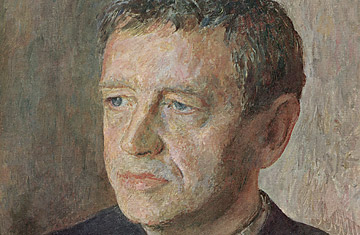
Portrait of the artist Andrew Wyeth done by his sister, Henriette Hurd.
(2 of 9)
"I am an outdoors painter," he says, and he spends most of his days outside. When he comes home, it is to a 200-year-old fieldstone house, newly remodeled so meticulously in Pennsylvania colonial style that when he first saw it all reconditioned he cracked: "Where do I register?" He has a handsome brunette wife named Betsy, and a pair of youthful, energetic sons.
There is plenty of money to go with all this: the prices that museums pay Wyeth regularly break records, and what he gets from the 60-odd private collectors who have his temperas has occasionally topped the museum prices. He may be the world's best-paid painter after Picasso—and part of the reason is Betsy. Once, 20 years ago, when he did a cover for the Saturday Evening Post for $1,000 and seemed tempted to take a contract with the magazine, she threatened to leave him. "It'll be the end of your painting," she said. Recently, at the suggestion of his dealer, M. Knoedler & Co., she incorporated him as The Mill, Inc., and The Mill pays Wyeth a salary.
A Dignified Recluse. But money does not preoccupy Andrew Wyeth, and his whimsies are mostly a cover-up for what engrosses him, the subjects of his work. The most famous of these is a woman named Christina Olson. He has painted eight temperas of her or her house, a decrepit three-story clapboard pile atop a knoll near the Maine seacoast. One of them, Christina's World, now 15 years old, is one of the most durable and disquieting images of 20th century America. Against the wall of landscape that leads up to her house, the crippled body of an ageless woman seems trapped, imprisoned by the very emptiness of the earth. Manhattan's Museum of Modern Art, which hesitated before buying it in 1948 for $2,200, has repaid its investment 22 times over in the sale of reproductions.
Christina, who is crippled by polio, is one of Wyeth's few close friends. He judges people by their reactions to her. "I don't take some people to see her," says Wyeth, "because they won't understand." He fears that they will find her grotesque. Christina's house contains the anonymous leavings of years of confinement. The smell of burning oil, charred wood, fat cats and old cloth fills the air. Christina, now nearing 70, does not let anyone see how she moves about, stubbornly refuses to use a wheelchair. "Andy's a very good friend," she says. "I like to pose for him. He talks a great deal when he paints, but he doesn't talk nonsense." She does not talk nonsense either. Despite her painful loneliness, she is dignified, proud and intelligent.
None of Wyeth's portraits of Christina look alike; the artist injects his own humanity into the people and places around him. More than anything else that Wyeth paints, Christina's individuality and inner strength are a mirror-portrait of the artist himself. She is a touchstone of his compassion.