

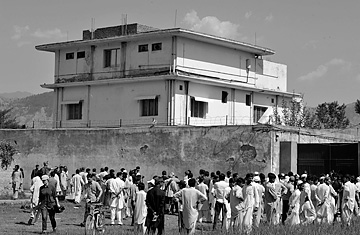
Pakistani media personnel and local residents gather outside the hideout of Al-Qaeda leader Osama bin Laden following his death by US Special Forces in a ground operation in Abbottabad on May 3, 2011.
(9 of 9)
Hearing the sounds of strange men rushing into their room, Amal screamed something in Arabic and threw herself in front of her husband. The first SEAL who charged into the room shoved her aside, concerned that she might be wearing a suicide-bomb vest. Amal was then shot in the calf by another of the SEALs, and she collapsed unconscious on the simple double mattress she shared with bin Laden. Bin Laden was offering no resistance when he was dispatched with a "double tap" of shots to the chest and left eye. It was a grisly scene: his brains spattered on the ceiling above him and poured out of his eye socket. The floor near the bed was smeared with bin Laden's blood.
The aging bin Laden may have grown complacent or tired during his decade on the run; he had no real escape plan, and there was no secret passageway out of his house. Perhaps he expected some kind of warning that never came. Or perhaps he knew that a firefight inside the enclosed spaces of his house would likely end up killing some of his wives and children.
For all his bluster that he would go down fighting and his bodyguards would shoot him if he were ever found by the Americans, when the moment finally came, there was no spectacular martyrdom. Bin Laden died surrounded by his wives in a squalid suburban compound awash in broken glass and scattered children's toys and medicine bottles — testament to the ferocity of the SEALs' assault on his final hiding place. And on Feb. 25, Pakistani authorities sent in a demolition crew that tore the complex down, erasing in a couple of days bin Laden's six-year sojourn in Abbottabad.
Adapted from Manhunt: The Ten-Year Search for Bin Laden — from 9/11 to Abbottabad, by Peter Bergen, to be published on May 1 by Crown Publishers, an imprint of Random House