

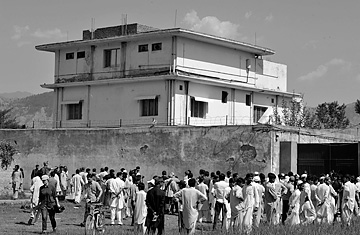
Pakistani media personnel and local residents gather outside the hideout of Al-Qaeda leader Osama bin Laden following his death by US Special Forces in a ground operation in Abbottabad on May 3, 2011.
(3 of 9)
The next wife in seniority in the bin Laden compound was Siham bin Abdullah bin Husayn, an exact contemporary of the 54-year-old al-Qaeda leader's. Siham had obtained a Ph.D. in Koranic grammar while she was living with bin Laden in Sudan in the mid-1990s. A poet and an intellectual, she would often edit bin Laden's writings.
Bin Laden had married his youngest wife Amal a year or so before the 9/11 attacks, when he was 43 and she was 17, but the 26-year age difference between them did not stand in the way of what seemed to be a love match. Amal bore bin Laden five children, including two while she and her husband were living in Abbottabad.
Family life in Abbottabad was a source of genuine solace for bin Laden, who believed deeply that polygamy and procreation were religious obligations. To his close male friends, he often repeated a saying attributed to the Prophet Muhammad: "Marry and increase in number because with you I increase the nation (of Muslims)." To other friends, he joked, "I don't understand why people take only one wife. If you take four wives, you live like a groom." (This seems to be the only recorded joke bin Laden ever made.) A clue as to how bin Laden was able to "live like a groom" may be the Avena syrup — a sort of natural Viagra made from wild oats — that was found at the compound after his death.
Life in the compound certainly wasn't luxurious, but for Amal it wasn't much different from the life she had known while growing up in rural Yemen. For meat, the more than a dozen members of the bin Laden family subsisted on two goats a week, which were slaughtered inside the compound. Milk came from cows housed in concrete sheds, eggs from some 100 chickens kept in cages, honey from bees in a hive and vegetables like cucumbers from the spacious kitchen garden. This homegrown produce was supplemented by cans of Sasso olive oil and cartons of Quaker Oats bought locally.
Inside its walls the compound was bare of paint, and in keeping with bin Laden's orthodox beliefs, there were no pictures. It had no air-conditioning and only a few rudimentary gas heaters — in an area where summers can top 100F and winters mean snow. As a result, the electricity and gas bills were relatively minuscule, averaging $50 a month. Beds for the various family members were made from simple planks of plywood. It was as if the compound's inhabitants were living at a makeshift but long-term campsite.
By virtue of her age and stern temperament, the oldest wife, Khairiah, was highest in the pecking order, but there was little fighting among bin Laden's spouses. All of them had gone into marriage knowing it would be a polygamous arrangement, something they believed to be sanctioned by God. Each wife had her own separate apartment with its own kitchen (with crude pipes funneling cooking smells to the outside). The third floor of the main building was Amal's domain, while on the floor beneath her lived the two much older wives.
Also living in the compound were bin Laden's trusted bodyguard and courier Abu Ahmed al-Kuwaiti (known as the Kuwaiti), the courier's brother and their wives and children. They lived in abject poverty. Bin Laden paid the Kuwaiti and his brother about 12,000 rupees a month each, a little more than $100, a reflection of the fact that al-Qaeda's coffers were nearly empty.