

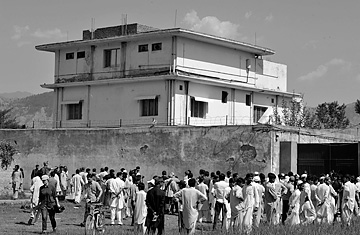
Pakistani media personnel and local residents gather outside the hideout of Al-Qaeda leader Osama bin Laden following his death by US Special Forces in a ground operation in Abbottabad on May 3, 2011.
(2 of 9)
It was to the placid environs of Abbottabad that bin Laden, half a decade after his great victory on 9/11, decided to escape. By the spring of 2011, the terrorist mastermind was in his sixth year of hiding out in the city's Bilal Town neighborhood. With its porticoed white villas interspersed with small shops selling fruits and vegetables, it is certainly a pleasant place to live. Sometime in 2005, bin Laden's compound began rising from what had once been open fields. During construction, a third floor was added to the main building. No planning permission was sought for this addition, a common enough dodge in a part of the world where paying property taxes is regarded as a sucker's game. But there was a more compelling reason to keep this alteration as secret as possible: the unauthorized floor was for the exclusive use of bin Laden and Amal, the spirited Yemeni who was his newest and youngest wife.
The third floor was a little different from the others. It had windows on only one of its four sides, and they were opaque. Four of the five windows were just slits well above eye level. A small terrace leading off the floor was shielded from prying eyes by a 7-ft.-high wall designed to conceal even someone as tall as the 6-ft. 4-in. bin Laden. Habitually dressed in light-colored flowing robes, a dark vest and a prayer cap, bin Laden rarely left the second and third floors of the house during the more than five years he lived there. When he did, it was only to take a brief walk in the compound's kitchen garden. A makeshift tarpaulin over a section of the garden was designed to keep even those walks a secret from the all-seeing U.S. satellites that traversed the skies overhead.
It must have been quite confining for an outdoorsman like bin Laden, but there were some compensations. For one thing, he was a long way from the U.S. drone strikes that were steadily picking off many of his longtime aides, the cream of al-Qaeda, in Pakistan's tribal regions some 200 miles to the west. Most important, he was surrounded by three of his wives and a dozen of his children and grandchildren.
The wives ranged in age from the 29-year-old Amal to the 62-year-old Khairiah, who had recently and happily reappeared in bin Laden's life quite unexpectedly after an absence of nine years. Bin Laden had married Khairiah in 1985, when he was 28 and she was 35. Before her marriage, Khairiah had had something of an independent career as a teacher of deaf-mute children. She also held a Ph.D. and hailed from a wealthy, distinguished family that claims descent from the Prophet Muhammad.
As the Taliban regime was imploding during the fall of 2001, Khairiah fled Afghanistan for neighboring Iran, together with several of bin Laden's children. For years they all lived under some form of house arrest in the Iranian capital of Tehran. Sometime during the blazing summer of 2010, Khairiah managed to travel to North Waziristan, a flinty, remote tribal region of Pakistan that lies more than 1,500 miles east of Tehran; the journey took her across tough mountain ranges and through some of the harshest deserts on earth. She then traveled on to Abbottabad to reunite with her husband.