

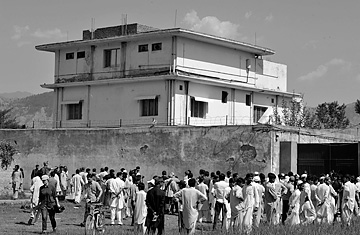
Pakistani media personnel and local residents gather outside the hideout of Al-Qaeda leader Osama bin Laden following his death by US Special Forces in a ground operation in Abbottabad on May 3, 2011.
(6 of 9)
Half an hour later, at about 11 p.m. local time, the two Black Hawks took off from the Jalalabad airfield and headed east toward the border with Pakistan, which they would cross in about 15 minutes. The choppers were MH-60s, modified so as to remain undetected by Pakistani radar stations, which were in peacetime mode, unlike the radar facilities on the border Pakistan shared with its longtime enemy India, which were always on heightened alert. Painted with exotic emulsions to help them evade detection, the modified MH-60s gave off a low heat signature in flight. Their tail rotors had been designed to make them less noisy and less susceptible to radar identification. On top of that, the helicopters flew "nap of the earth," which means perilously low and very, very fast — only a few feet above the ground, driving around trees and hugging the riverbeds and valleys that lace the foothills of the Hindu Kush mountain range. This also made them harder to detect by radar. After crossing the border, the choppers swung north of Peshawar and its millions of residents and eyeballs. The total flight time to the target was about an hour and a half, the distance about 150 miles.
Adjoining the White House Situation Room, which can accommodate more than a dozen senior officials at a large, highly polished wooden table and a couple dozen more staffers on the backbencher seats along the walls, is a much smaller meeting room. Like the Sit Room, this room has secure video and phone communications, but it has only a small table and can comfortably accommodate only seven people. In this room was Brigadier General Marshall "Brad" Webb, assistant commanding general of JSOC, dressed in a crisp blue Air Force uniform festooned with ribbons, to monitor the SEAL teams in real time on a laptop, together with another JSOC officer. On the monitors of the small conference room, grainy video of the unfolding raid was fed in from a bat-shaped RQ-170 Sentinel stealth drone flying more than two miles above Abbottabad.
Michael Leiter, director of the National Counterterrorism Center, went into the small conference room to watch the feed from the stealth drone and was soon followed by members of Obama's Cabinet. "Slowly, onesies and twosies, they kept poking their heads in," Leiter recalls. Vice President Joe Biden drifted in, then Defense Secretary Robert Gates and Secretary of State Hillary Clinton, and suddenly the room was full, with many of Obama's top intelligence and counterterrorism officials jammed up against the walls or stuck outside, peering through the doorway to get a better look at the unfolding drama. Obama then stepped in, announced, "I need to watch this," and settled into a chair off to one side of the cramped room, next to Webb. (It was here, not in the Sit Room proper, that the famous image of the President and his team would be taken.)