

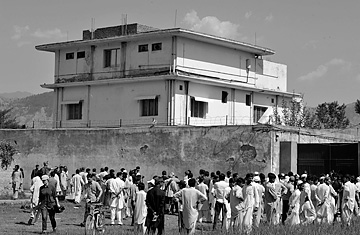
Pakistani media personnel and local residents gather outside the hideout of Al-Qaeda leader Osama bin Laden following his death by US Special Forces in a ground operation in Abbottabad on May 3, 2011.
(4 of 9)
A modest one-story building housed the Kuwaiti and his family. A 7-ft.-high wall separated it from the main house, where bin Laden lived. The Kuwaiti's wife Mariam rarely went into the big house except to do cleaning; only once, in the spring of 2011, did she catch a glimpse of a strange, tall man speaking Arabic. Her husband had explained to her years earlier that there was a stranger living there and instructed her never to talk about him. Bin Laden was hiding even from some of the people living in his own compound.
In his top-floor sanctuary, bin Laden whiled away the days with Amal. The bedroom ceiling was low for a man as tall as bin Laden. A tiny bathroom off to the side had green tile on the walls but not on the floor, a rudimentary toilet that was no more than a hole in the ground, over which they had to squat, and a cheap plastic shower. In this bathroom, bin Laden regularly applied Just for Men dye to his hair and beard to try to maintain a youthful appearance now that he was midway through his sixth decade. Next to the bedroom was a kitchen the size of a large closet. Across the hall was bin Laden's study, where he kept his books on crude wooden shelves and spent much of his time tapping away on his computer, composing lengthy missives that would be delivered by courier to key lieutenants.
In memos he never dreamed would one day end up in the hands of the CIA, bin Laden advised other militant jihadist groups not to adopt the al-Qaeda moniker. On Aug. 7, 2010, he wrote to the leader of the brutal al-Shabab militia in Somalia to warn that declaring itself part of al-Qaeda would only attract enemies and make it harder to raise money from rich Arabs.
In October 2010, bin Laden wrote a 48-page memo to one of his deputies that surveyed the state of al-Qaeda's jihad. He began on an optimistic note, observing that for the Americans it had been "the worst year for them in Afghanistan since they invaded," a trend he predicted would only be amplified by the deepening U.S. budget crisis. But bin Laden also worried that al-Qaeda's longtime sanctuary in Waziristan, in Pakistan's tribal areas, was now too dangerous because of U.S. drone strikes. "I am leaning toward getting most of our brothers out of the area," he wrote.
Bin Laden fretted about his 20-year-old son Hamza, who had moved to the tribal regions sometime in 2010, writing, "Make sure to tell Hamza that I am of the opinion he should get out of Waziristan ... He should move only when the clouds are heavy." While publicly calling for young men to join his holy war, bin Laden was privately advising that his son decamp for the tiny, prosperous Persian Gulf kingdom of Qatar.
Bin Laden also reminded his deputies "that all communication with others should be done through letters" rather than by phone or the Internet. As a result, he had to wait up to two or three months for responses to his queries, which made running al-Qaeda far from efficient.