

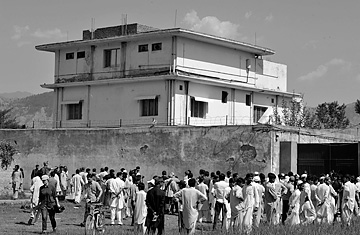
Pakistani media personnel and local residents gather outside the hideout of Al-Qaeda leader Osama bin Laden following his death by US Special Forces in a ground operation in Abbottabad on May 3, 2011.
(5 of 9)
Bin Laden was always scheming about how to grab more media attention. He instructed his team, "The 10th anniversary of the 9/11 attack is coming and due to the importance to this date, the time to start preparing is now. Please send me your suggestions on this." He proposed reaching out to the correspondents of both al-Jazeera English and al-Jazeera Arabic and wondered if he could get a hearing on an American TV network: "We should also look for an American channel that can be close to being unbiased such as CBS."
Until the end, bin Laden remained fixated on mounting another large-scale attack on the U.S., prodding one deputy, "It would be nice if you could nominate one of the qualified brothers to be responsible for a large operation against the U.S. It would be nice if you would pick a number of the brothers not to exceed 10 and send them to their countries individually without any of them knowing the others to study aviation."
Bizarrely, he complained that Faisal Shahzad — a U.S. citizen of Pakistani heritage trained by the Pakistani Taliban, who had tried to blow up an SUV in Times Square on May 1, 2010 — had broken the oath of allegiance he had sworn to the U.S., and he tut-tutted that "it is not permissible in Islam to betray trust and break a covenant." This seeming aversion to recruiting U.S. citizens narrowed the available options. In any case, his top deputy Ayman al-Zawahiri pushed back, telling bin Laden it was much more realistic to attack American soldiers in Afghanistan than civilians in the U.S.
Indeed, by the spring of last year, bin Laden and his men hadn't mounted a successful attack in the West since the July 7, 2005, transportation bombings in London. And al-Qaeda had, of course, never managed to pull off a successful attack in the U.S. after Sept. 11, 2001.
Launching Neptune's Spear
At 1 P.M. E.T. on Sunday, May 1, as night fell 7,000 miles to the east, in Pakistan, President Obama's war Cabinet began to gather in the Situation Room. The White House national-security team had set up secure communications there, connected to Vice Admiral William McRaven, commander of the Joint Special Operations Command (JSOC), who was by now in Jalalabad, in eastern Afghanistan. The Sit Room was also in secure communication with Leon Panetta's offices at the CIA headquarters and the Ops Center in the Pentagon, where a team of some 30 officers was standing by to respond to any contingency. At 2 p.m., Obama entered the Sit Room for the final meeting with his national-security team as Operation Neptune's Spear commenced. At 2:05 p.m., Panetta began one more overview of the operation.
It was now past 11 p.m. in Abbottabad, and the bin Laden household was in bed. Given the time difference between Afghanistan and Pakistan, it was just past 10:30 p.m. in Jalalabad, where the U.S. Navy SEAL team, consisting of 23 "operators" and an interpreter, were preparing to board two Black Hawk choppers. The men carried small cards filled with photos and descriptions of bin Laden's family and the members of his entourage who were believed to be living at the compound. Also along for the operation was a combat dog named Cairo, wearing body armor just like his SEAL teammates.