

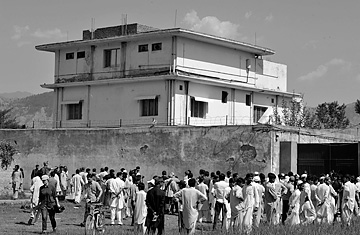
Pakistani media personnel and local residents gather outside the hideout of Al-Qaeda leader Osama bin Laden following his death by US Special Forces in a ground operation in Abbottabad on May 3, 2011.
(8 of 9)
Meanwhile, the second Black Hawk pilot saw what had happened to the first chopper and shifted gears. Plan A had been to hover above the roof of bin Laden's bedroom so that a few SEALs could fast-rope onto it and surprise bin Laden while he slept. Now the pilot opted for Plan B: the safer course of settling the bird down just outside the compound walls in a field of crops. A small group of SEALs jumped out, four of them to secure the outside perimeter of the compound. The remaining eight SEALs on the second chopper jumped out and set an explosive charge on a solid metal door on one of the compound's exterior walls, but when the gate was blown off its hinges, they were greeted by the sight of a large brick wall — a dead end. Soon after that, their colleagues from the downed chopper let them in through the main gate of the compound, saving them the trouble of blowing through the massive, thick exterior wall.
Up in his top-floor bedroom, bin Laden had become a victim of his own security arrangements. The few windows ensured that no one could look in to see him, but now it was impossible for him to see what was going on outside. Dressed in tan shalwar kameez, a loose-trousers-and-tunic outfit, the leader of al-Qaeda waited in the dark in silence for about 15 minutes, seemingly paralyzed as the Americans stormed his last refuge. With no moon and the electricity out, it was pitch black, which must have added to his confusion. Sewn into his clothing were several hundred euros and two phone numbers, one for a cell phone in Pakistan and the other for a call center in Pakistan's tribal regions. This was the extent of bin Laden's escape plan, and it wasn't going to be of much help to him now.
Three SEALs went from the Kuwaiti's one-story building through a metal gate in a wall inside the compound and found themselves in a grassy courtyard in front of the main house. The SEALs entered the ground floor. On their left was a bedroom where they shot Abrar, the Kuwaiti's brother, and his wife Bushra, killing them both.
The SEAL team had no idea what the layout of the floors in bin Laden's house might be. As they moved deeper inside, they passed a kitchen and two large storage rooms. Near the back of the house, which had a bunker-like feel, was a stairwell. Blocking their way to the upper two floors was a massive, locked metal gate. The SEALs blasted their way through this gate with the breaching materials they were carrying. As the SEALs ran up to the second floor, they encountered bin Laden's 23-year-old son Khalid, whom they shot on the staircase.
On a shelf in bin Laden's bedroom were the AK-47 and Makarov machine pistol that were his constant companions, but he didn't reach for them. Instead he opened a metal gate, which blocked all access to his room and could be opened only from the inside, and quickly poked his head out to see what the commotion was. He was immediately spotted by the SEALs, who bounded up the next flight of stairs. Retreating inside, bin Laden made the fatal error of not locking the gate behind him, allowing the SEALs to run past it into a short hallway. They then turned right into his bedroom.