

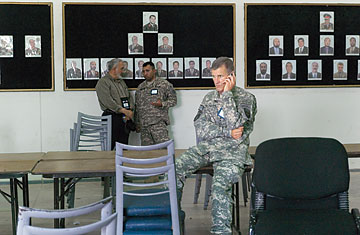
General Stanley McChrystal holds crisis talks on his phone at a local ANA (Afghan National Army) base.
(5 of 6)
In between stints with various special-operations units, McChrystal pulled tours at the Council on Foreign Relations and Harvard. Before coming to the Pentagon, he spent 2003 to 2008 heading up the Joint Special Operations Command, the secret corps of Army Delta Force and Navy Seals based at Fort Bragg in North Carolina, although McChrystal deployed regularly to its forward post inside Iraq. In 2006 his unit succeeded in tracking down and killing Abu Mousab al-Zarqawi, the leader of al-Qaeda in Iraq. McChrystal's record has not been without controversy. After the 2004 death by friendly fire of former NFL player and Army Ranger Pat Tillman in Afghanistan, Pentagon investigators said McChrystal provided information that misleadingly suggested Tillman died at the enemy's hands when recommending him for the Silver Star. But the Army decided that McChrystal had "no reasonable basis" for second-guessing officers who drafted the recommendation.
Fit as a tuning fork, McChrystal has a certain monkish mythology about him that his aides seem keen to foster. In Afghanistan, they say, he gets up at 4 a.m. to run and e-mail before his workday really begins with an 8:30 video briefing with his regional commanders across the country. His iPod and Kindle (the newest model) are stocked by his wife with serious tomes on Pakistan, Lincoln and Vietnam. Right now, he is reading William Maley's 2002 book The Afghanistan Wars, a catalog of the long list of foreign failures in Afghanistan. McChrystal famously eats little during the day, recently only picking at an Afghan spread featuring four kinds of meat. To the chagrin of Afghans, who see drinking tea as an inalienable human right, he scrapped a morning tea break at a recent security briefing in Kandahar, and aides grumble, nicely, that he sees others' demands for lunch as a sign of weakness. (But he makes up for it at dinner: a colleague says a typical evening repast may include a cheeseburger, a fajita burrito, a pile of fries and ice cream. And maybe a brownie.) And if it weren't for uniforms and the help of his wife, he wouldn't have a clue what to wear. His tenor voice is soft, but his gaze--fixed on his target--can make subordinates squirm. If he takes off his glasses, says an aide, "you know you're in trouble."
Watching in Washington
Military policy in Afghanistan is now in the hands of this likable and very, very focused soldier. An Administration and a nation are waiting to see if his plan is any better than the one it replaced. Time is in short supply. Some in Washington are leery of Afghanistan's becoming another Vietnam. Representative David Obey, the Wisconsin lawmaker who chairs the powerful Appropriations Committee, said in May he's giving the White House a year to show progress--however defined--in Afghanistan. But at his confirmation hearing, McChrystal said he expects it will take 18 to 24 months to see whether things are turning around, and talking to TIME, he was clear that it will take even longer than that to make "permanent progress."