

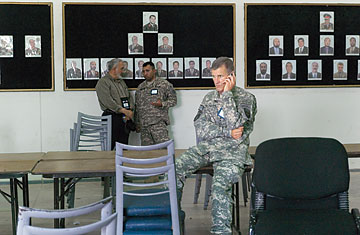
General Stanley McChrystal holds crisis talks on his phone at a local ANA (Afghan National Army) base.
(3 of 6)
Terrorism and the illicit drug trade have flourished in Afghanistan because the lack of a functioning economy has let warlords fill the vacuum. That needs to change. The U.S. recently announced, for example, that it is shifting its antipoppy efforts from destroying the opium-producing flowers to encouraging different crops. But that's quite a challenge: poppies are easy to grow and net four times as much money per acre as wheat. So farmers will need new cash crops to replace the poppies and newly built roads to get such goods to market without paying bribes along the way. The best soldiers in the world can't manage every step of that process, which is why Karl Eikenberry, the new U.S. ambassador in Kabul and a retired Army lieutenant general who served twice in Afghanistan, says, "The military can help set the conditions for success. But it is not sufficient for success."
That said, without the military doing its bit, there will be no success to measure. So part of the Obama Administration's strategy is to increase the number of U.S. troops in Afghanistan, from 57,000 now to 68,000 by the fall. The extra troops should help bring security to parts of Afghanistan that lack it, but McChrystal is clear that security alone is but a means to an end. "The point of security," he says, "is to enable governance ... My metric is not the enemy killed, not ground taken: it's how much governance we've got." Decent governance, the thinking goes--providing the rule of law and economic opportunity--will persuade those who take up arms because they have no other economic alternative to stop fighting. And those who don't use words like governance agree. "If people have work," says Mohammad Ismael, a 58-year-old Kabul resident, "I don't think they will fight."
Unshocked, Unawed
The new strategy, with its limits on actions that risk civilian casualties, represents a sea change in U.S. military doctrine. It was only six years ago that Air Force General Richard Myers, then Chairman of the Joint Chiefs of Staff, predicted that a shock-and-awe strategy would bomb Saddam Hussein's Iraq into submission. That--and the tech-heavy force that then Defense Secretary Donald Rumsfeld sent into Iraq to stumble and falter for four years--hewed to the American way of war, one that was equal parts laser beams and hubris. But the military has rethought its strategy. "You can shock and awe human beings," McChrystal says, "but it doesn't last. I've seen operations where kinetic strikes would go in on a target, and the enemy would come out shooting. They weren't awed."
Instead of relying on brute force, McChrystal has to find more subtle ways of dealing with an Afghan insurgency that grows out of a patchwork of motivations based on tribal allegiances, Islamic fundamentalism and the strategies of warlords eager to keep what has been theirs for generations. "I am not sure," McChrystal says, "there are two different people out there with the same reason for the fight." He has to untangle the various threads in this skein and then determine what action--economic development, strong government, death--works best in each case.