

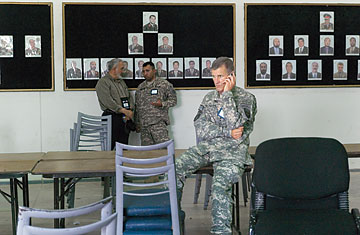
General Stanley McChrystal holds crisis talks on his phone at a local ANA (Afghan National Army) base.
The headquarters of the International Security Assistance Force (ISAF) in Kabul looks more like a college campus than the nerve center of a military operation involving more than 90,000 troops from 41 countries, its staff officers roaming the halls in each nation's distinct patterns of camouflage. On July 3, on a wooden deck at the back of his office in the compound, shaded by trees and a garden umbrella, U.S. Army General Stanley McChrystal, who recently became ISAF's commander, and that of U.S. forces in Afghanistan, sat down to discuss his new role. Tall, lanky and earnest, with the loping stride of a long-distance runner--McChrystal runs 10 miles before his morning coffee--the general went to Afghanistan after a top job with the Joint Chiefs of Staff in Washington. He knows Afghanistan well. The conflict there, McChrystal told TIME, is a "tough war, a very tough war."
That it most certainly is. In October it will have been eight years since U.S. forces first went into combat in Afghanistan against al-Qaeda and its local supporters in the Taliban. That makes the war there the second longest (after Vietnam) in U.S. history. More than 1,200 coalition troops have died in Afghanistan; some 730 of the dead were American, but other nations have suffered too. Britain has lost 175 soldiers in the conflict, and Canada 124. And the deaths in uniform are the easy ones to count: they do not encompass the thousands of Afghan villagers who have been killed by the Taliban or by errant coalition actions. Last year alone, 828 civilians were killed by U.S., allied or Afghan troops, 552 of them in air strikes.
It is precisely because so many Afghans have been killed that the war is, in effect, starting anew. McChrystal's task is to recalibrate the war effort so local people can see that the coalition's actions increase their security, in turn allowing them to get on with their lives. Up to now, the deaths of Afghans in the fighting have done little to aid the allies and a lot to turn locals against foreign forces and the government of President Hamid Karzai, which those forces sustain. This is a place--as British and Russian armies discovered and were sent packing after their discoveries--where the waters of vengeance run deep. "If the Americans kill an Afghan father, the son will take revenge and pick up a gun and will stand against foreigners," says Abdul Qadir, 38, who runs a shoe-shine business on a Kabul street. "People hate Americans," echoes Ezatullah, a driver from the town of Maidan Shahr, "because they kill innocent people."