

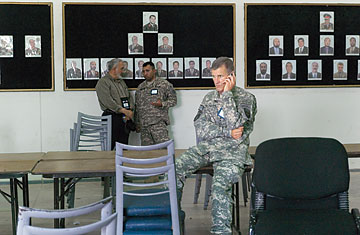
General Stanley McChrystal holds crisis talks on his phone at a local ANA (Afghan National Army) base.
(4 of 6)
And he has to be a diplomat too. Perhaps the most important military action in the region isn't happening in Afghanistan but across the border in Pakistan. Afghanistan and Pakistan, McChrystal says, are "unique situations that are linked inextricably." Islamabad's fitful offensive against the Taliban in Pakistan has successfully drained resources from the Taliban in Afghanistan. "Money is drying up," Colonel John Spiszer, commander of the 3rd Brigade Combat Team, 1st Infantry Division, along the border, said on June 23. Over the past year, the going prices for guns and ammo "have almost doubled," he noted. "That's a great sign." Such pressure on safe havens in Pakistan will reduce hit-and-run attacks across the border.
But however much the Pakistanis help, McChrystal does not have an easy job. He concedes that Afghanistan's current security forces--86,000 soldiers and 82,000 national police--aren't enough to protect the country. And U.S. commanders have made it clear that even with reinforcements in the pipeline, they don't have enough troops to run a full-fledged counterinsurgency campaign. That is one reason U.S. commanders came to rely on airpower, which only perpetuated a feedback loop that made the job of winning trust among Afghans even harder.
Long Career, Fresh Eyes
In Washington there had been a sense for months that the Afghan train was off the track and that McKiernan--an able armor officer--wasn't the right fit. On May 11, Defense Secretary Robert Gates, with Obama's blessing, tapped McChrystal for the Afghan post, saying "fresh eyes" were needed on the war.
McChrystal's official career is 33 years long, but he has, in effect, been in the Army for all his 54 years--both his father and paternal grandfather were Army officers, his father making it to two-star general. After graduating from West Point in 1976--31 years after his father--McChrystal climbed the Army ladder. He's seen some tragedies. In 1994, McChrystal was a lieutenant colonel with the 82nd Airborne Division when a flaming F-16 jet plowed into a parked C-141 at Pope Air Force Base. The cargo plane's 55,000 gallons of jet fuel erupted into a massive fireball, killing 18 of McChrystal's troops as they prepared for parachute jumps on a sunny North Carolina afternoon.
Asked about the incident, McChrystal pauses for nine seconds, his mood shifting from animated to muted. "We sent our own paratroopers to bury each of our own killed," he says, saying the tragedy taught him the importance of teamwork. Others say it showed his leadership. McChrystal and his wife Annie attended all the funerals and memorial services. "That was real moral courage," says Dan McNeill, who was McChrystal's commander at the time and who later ran the war in Afghanistan. "I don't know if I could have done that."