

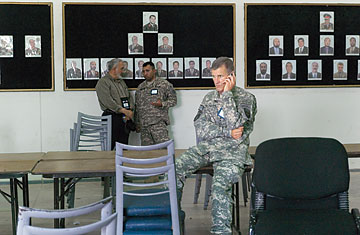
General Stanley McChrystal holds crisis talks on his phone at a local ANA (Afghan National Army) base.
(2 of 6)
To drain the hatred and give Afghanistan the room to build institutions and an economy that just might, one day, heal the wounds of 30 years of war, President Barack Obama and his generals are shifting strategies. Their new doctrine emphasizes protecting the Afghan people over killing insurgents. "What we really want is the equivalent of a peaceful takeover, where the Taliban are forced out," McChrystal told TIME. Three days later, the general issued a "tactical directive" to ISAF forces reinforcing the point: "We will not win based on the number of Taliban we kill," McChrystal wrote, "but instead on our ability to separate insurgents from the people." To that end, the directive explicitly enjoined force leaders "to scrutinize and limit the use of force like close air support against residential compounds and other locations likely to produce civilian casualties." In truth, the new policy was already being applied: on July 2, nearly 4,000 Marines and 650 Afghan troops stormed into Helmand province in southern Afghanistan aboard helicopters and armored vehicles. But within hours, the Marines issued a statement declaring they had "not used artillery ... and no bombs have been dropped from aircraft" in the offensive's opening thrust. You know a war has turned topsy-turvy when U.S. Marines brag about the weapons they're not using.
The change in tactics and command (on June 15, McChrystal was brought in to replace Army General David McKiernan, who had led ISAF since June 2008) was necessitated by a grim truth. The war in Afghanistan is not going well. The Taliban, funded in large measure by the opium trade, which is centered in Helmand, now controls wide swaths of Afghanistan. Over the past four months, a recent U.N. report says, the number of "assassinations, abductions, incidents of intimidation and the direct targeting of aid workers" has been higher than last year. Increasing numbers of foreign fighters--"most likely affiliated with al-Qaeda"--are fighting alongside the Taliban. "There is no question but that the situation has deteriorated over the course of the past two years," General David Petraeus, who as chief of U.S. Central Command oversees the wars in both Afghanistan and Iraq, said recently.
The Second Afghan War
The offensive in Helmand is the first step in what has become America's second Afghan war. The Marines have met little resistance, although U.S. deaths spiked elsewhere in the country. On July 6, seven U.S. troops were killed outside Helmand--the highest daily toll in nearly a year. Using an age-old strategy, the insurgents seem to have melted away when pressured, only to pop up and attack elsewhere. In Helmand, U.S. troops will set up small outposts instead of pulling back when the operation is done. They'll live near the locals and offer protection in advance of Afghanistan's Aug. 20 presidential election. Then McChrystal's forces and civilian advisers will begin trying to build economic and governmental institutions.