

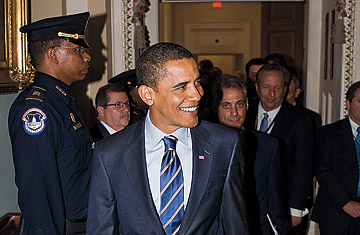
President-elect Barack Obama
John Maynard Keynes, the trendiest dead economist of this apocalyptic moment, was the godfather of government stimulus. Keynes had the radical idea that throwing money at recessions through aggressive deficit spending would resuscitate flatlined economies--and he wasn't too particular about where the money was thrown. In the depths of the Depression, he suggested that the Treasury could "fill old bottles with banknotes, bury them at suitable depths in disused coal mines" then sit back and watch a money-mining boom create jobs and prosperity. "It would, indeed, be more sensible to build houses and the like," he wrote, but "the above would be better than nothing."
As President-elect Barack Obama prepares to throw money at the current downturn--a stimulus package starting at about $800 billion, plus the second $350 billion chunk of the financial bailout--we all really do seem to be Keynesians now. Just about every expert agrees that pumping $1 trillion into a moribund economy will rev up the ethereal goods-and-services engine that Keynes called "aggregate demand" and stimulate at least some short-term activity, even if it is all wasted on money pits.
But Keynes was also right that there would be more sensible ways to spend it. There would also be less sensible ways to spend it. A trillion dollars' worth of bad ideas--sprawl-inducing highways and bridges to nowhere, ethanol plants and pipelines that accelerate global warming, tax breaks for overleveraged McMansion builders and burdensome new long-term federal entitlements--would be worse than mere waste. It would be smarter to buy every American an iPod, a set of Ginsu knives and 600 Subway foot-longs.
It would be smarter still to throw all that money at things we need to do anyway, which is the goal of Obama's upcoming American Recovery and Reinvestment Plan. It will include a mix of tax cuts, aid to beleaguered state and local governments, and spending to address needs ranging from food stamps to computerized health records to bridge repairs to broadband networks to energy-efficiency retrofits, all designed to save or create 3 million to 4 million jobs by the end of 2010. Obama has said speed is his top priority because the faster Washington injects cash into the financial bloodstream, the better it stands to help avert a multiyear slump with double-digit unemployment and deflation. But he also wants to use the stimulus to advance his long-term priorities: reducing energy use and carbon emissions, cutting middle-class taxes, upgrading neglected infrastructure, reining in health-care costs and eventually reducing the budget deficits that exploded under George W. Bush. Obama's goal is to exploit this crisis in the best sense of the word, to start pursuing his vision of a greener, fairer, more competitive, more sustainable economy.