

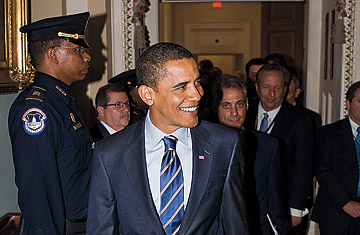
President-elect Barack Obama
(2 of 8)
Unfortunately, while 21st century Washington has demonstrated an impressive ability to spend money quickly, it has yet to prove that it can spend money wisely. And the chum of a 1 with 12 zeros is already creating a feeding frenzy for the ages. Lobbyists for shoe companies, zoos, catfish farmers, mall owners, airlines, public broadcasters, car dealers and everyone else who can afford their retainers are lining up for a piece of the stimulus. States that embarked on raucous spending and tax-cutting sprees when they were flush are begging for bailouts now that they're broke. And politicians are dusting off their unfunded mobster museums, waterslides and other pet projects for rebranding as shovel-ready infrastructure investments. As Obama's aides scramble to assemble something effective and transformative as well as politically achievable, they acknowledge the tension between his desires for speed and reform. "We're living that tension every day," an adviser tells TIME.
In this four-alarm economic emergency (nearly 2 million jobs have vanished in four months), it's easy to forget that shovel-ready doesn't necessarily mean shovel-worthy. Many projects are shovel-ready now only because they failed to clear the spectacularly low bar Congress set for pork in the past. Even if we're freaking out about today--and we should be--we can't afford to leverage tomorrow to build the infrastructure equivalent of buried banknotes, not when the deficit is a record $1.2 trillion and the debt a staggering $10.6 trillion. A depression would make both problems worse--tax revenues plunge when incomes plunge--but every public dollar we spend on depression avoidance also plunges us deeper into our hole. It's a bit galling to hear Republican leaders warn that Obama wants to spend money borrowed from our children when their own appetite for pork and tax breaks helped double the debt during the Bush years, but their hypocrisy does not make them wrong. If we're going to spring for another trillion, we need real returns on our investment.
That will require more than speedy spending. It will require a quick overhaul of Washington's spending priorities and spending processes. In other words, speedy reform.
Not Just a Deal--a New Deal
Obama hasn't yet released details of his plan, so the debate has so far focused on the overall dollar amount (liberals want more, conservatives less) and general makeup (liberals want fewer tax cuts, conservatives more) rather than specific strategies for priming the pump. But the clichés are true: God--or the devil--will be in the details.
For example, if you want to upgrade infrastructure, there's a big difference between fixing and building. When you fix a road, the dollars you spend reduce your need for future road repairs. When you build a road, you increase your need for future road repairs. Repairs are also quicker to get moving than new construction, and the Federal Highway Administration has calculated that repairs create 9% more jobs per dollar spent. And while repairs eliminate potholes and other problems that cost motorists time and money, new construction tends to produce rural or exurban sprawl roads that promote speculative development, overstretch municipal services, lengthen commutes and increase gasoline consumption and emissions.