

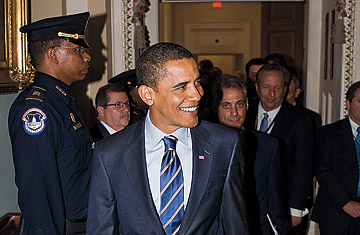
President-elect Barack Obama
(7 of 8)
These days, House Transportation and Infrastructure chairman Oberstar is flacking a Rebuild America plan that pays new respect to transit, but it still puts highways first; you can't expect too much reform from a guy who's served as a staffer or member of Capitol Hill's prime pork committee since 1963, a guy who earmarked a $3 million highway in the last transportation bill to relieve the notorious congestion between County Road 565 in Hoyt Lakes, Minn., and the intersection of Highways 21 and 70 in Babbitt. Meanwhile, states like Alabama, Kansas and Texas have been releasing lists of shovel-ready transportation projects that are dramatically skewed toward out-of-the-way sprawl roads. Missouri's list was all roads, none of them in St. Louis. Obama has vowed to reject earmarks, but if Congress simply passes cash to the states according to the usual formulas--and it will unless Obama intervenes--America is in for yet another festival of asphalt. There is even talk of waiving the regular cost-sharing requirements for local and state governments, an excellent way to make sure they green-light oinkers they would never pay for themselves.
The obvious solution would be some kind of independent arbiter to establish performance measures and evaluate stimulus projects for timeliness and tails as well as competitiveness and carbon. During his campaign, Obama proposed an infrastructure bank that wouldn't finance projects that don't produce economic or environmental returns. But Oberstar hasn't put in 45 years just to cede power to a commission. "It's like turning around a battleship," Puentes says. "And we just don't have the time."
The Psychology of Stimulus
So the scramble is on. The big splash water park--complete with a gym and "quality meeting space"--might sound like a waste of $22 million, but it would provide a nice stimulus for the people of Gastonia, N.C. The travel industry wants a $10 million loan to promote the U.S. as a destination, a tougher job these days. To the American Apparel & Footwear Association, this crisis only highlights the need to eliminate import tariffs on shoes. "Building self-esteem is critical," explains Matt Rubel, CEO of the parent company of Payless, "and not having a new pair of shoes--you know, having a pair that's tattered and doesn't fit--that does not create good self-esteem."
Let's face it: fiscal stimulus is a frustratingly inexact science. Nobody knows precisely what it will do in the short term, and in the long term, it isn't that different from any other government spending, except that the point of the spending can be the spending itself. As always, there will be winners and losers; it's impossible to stimulate everyone equally. In two years, if the recession is over, skeptics will claim it would have ended regardless of the stimulus. If it lingers, proponents will credit the stimulus for preventing a drearier outcome. As with the first round of the financial bailout, its most important short-term effect will probably be psychological, calming markets by sending a message of government engagement.