

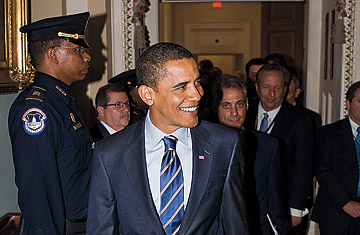
President-elect Barack Obama
(5 of 8)
The first element will be giving money to state and local governments to offset their shortfalls and prevent them from raising taxes, slashing services and downsizing public employees. Just about every economist wants this aid approved yesterday because just as public dollars can have a big multiplier effect, public cuts that are imminent in New York, California and Florida can have a negative multiplier effect. "You can't let the safety net unravel just when people need it most," says Len Burman, director of the nonpartisan Tax Policy Center. "A lot of states have been terribly irresponsible, but this probably isn't the best time to teach them a lesson."
But when will there be a better time? We should bail out the public sector, but only with serious strings attached; otherwise, we'll repeat the bailout of the financial sector, which pocketed the federal handouts and kept doing whatever it pleased. Bailouts should be reserved for states and communities facing the most drastic contractions--and even those shouldn't be rewarded for frittering away surpluses on sunny-day tax cuts and race-to-the-bottom subsidies designed to lure out-of-state businesses. States shouldn't be rewarded for keeping their fiscal houses in order by stiffing Medicaid programs either.
Obama's team has proposed increasing the federal share of Medicaid in exchange for assurances that states won't knock more families off their rolls. And his advisers hope to direct the aid where it's needed most--a tough sell in the Senate, where every state has equal power. But Obama should drive a hard bargain. He could provide more aid to states that promote energy efficiency through building codes and incentives for utilities. He could funnel aid directly to transit agencies and metropolitan governments, which tend to be more progressive than states. He could take Senate minority leader Mitch McConnell's advice and give loans instead of grants, which would both help the Treasury down the road and encourage states to make wise investments. He could require states that receive bailouts to promote wind and solar, expand health coverage or buy fuel-efficient police cars. If they don't want to, they don't have to take handouts. The bottom line should be: federal money, federal priorities.
Obama's second strategy will be giving money to people--through tax cuts as well as food stamps, jobless benefits and health care for the unemployed. Direct transfers are the fastest way to ship money out of the Treasury, but they don't provide stimulus if they don't get spent. That's what happened last year to a $168 billion stimulus package that relied on income tax rebates--remember when $168 billion was a big deal?--but foundered when many recipients hoarded the cash or paid down credit-card debt. It turns out that smart personal-finance decisions make for a lousy stimulus.
It also turns out that the best way to boost the economy by giving away money is to give it to people who can't afford to save it. That's why food stamps work so well as a stimulus. And that's why Obama is pushing a permanent $500-per-person credit on payroll taxes for every worker making less than $200,000 a year. But his rationale for broad-based relief goes beyond stimulus: he has repeatedly promised a fairer tax code that would make work pay for everyone, and this might be his last chance to play with an extra $1 trillion.