

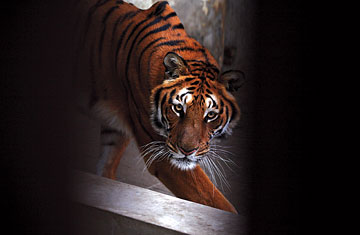
On the prowl
A South China tiger in his cage at the Suzhou South China Conservation Base
(8 of 8)
Environmentalists respond that if the U.S. fails to act, the tiger will almost surely disappear in the wild. Noting that Taiwan and China have "been tried and convicted by CITES and the U.S.," Earth Island's LaBudde says, "A judgment of guilty with no penalty imposed hardly represents any deterrent." Thornton of the EIA agrees: "It is time for us to make it plain that we are not going to stand by and watch the last tiger disappear."
But the remedy is not that simple. Even if international pressure eliminated poaching, the tiger would still be in trouble. Its habitat is shrinking, and its food supply is dwindling as the territory claimed by humans inexorably expands. Can people be comfortable living in close proximity to hungry predators who on occasion eat humans? Says Geoffrey Ward, author of The Tiger- Wallahs: "Poaching is murder, but crowding is slow strangulation."
Given the pressures on habitat, some zoologists maintain that captive breeding of tigers and their eventual reintroduction into the wild should be pursued as a way to keep the species alive. Schaller and many other ; conservationists dismiss this approach as both inefficient and unrealistic. Tigers learn from their mothers subtle details about hunting that would be difficult for human mentors to teach. And once tigers have disappeared from an area, Schaller notes, it becomes extremely difficult to convince villagers that they should welcome the animals back. "It would cost millions to breed and reintroduce tigers," says the biologist. "If Asian nations want tigers, they can have them far more cheaply by protecting the remaining wild tigers."
Oddly, the Siberian tiger -- a critically endangered subspecies -- may have the best chance of survival, but only if poaching is controlled. "The Amur tiger has 800 miles of unbroken habitat to move through," says Howard Quigley, who is co-director of the Siberian Tiger Project, a Russian-American conservation effort, "but unless poaching is stopped, there will be no tigers to move through it." The Tiger Trust and the World Wildlife Fund offered vehicles, training and supplemental pay for Russian wildlife rangers, but the killing of tigers continued as those proposals languished for months on the desks of bureaucrats in Moscow. Only last week did the first, unarmed patrol go out.
For the majority of tigers, India is where the battle for survival will be won or lost. It is not the best place to make a stand, given the extreme pressures of human population growth. Says Kamal Nath, the country's Environment Minister: "The threat to the tiger has never been so strong or so real." On the other hand, India has invested $30 million during the 20 years of Project Tiger and has a culture in which many people still genuinely respect nature. Here is where the world will see if humans and tigers can live side by side.
The two species have coexisted for hundreds of thousands of years. Up until now, the big cat has always been extraordinarily adaptable and resilient. "All a tiger needs," says Schaller, "is a little bit of cover, some water and some prey." But the tiger has finally run afoul of mankind, an evolutionary classmate that has proved to be an even more resourceful killer. "What will it say about the human race if we let the tiger go extinct?" asks TRAFFIC's Ashok Kumar. "What can we save? Can we save ourselves?"