

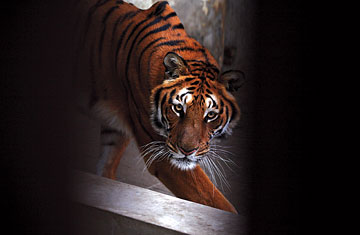
On the prowl
A South China tiger in his cage at the Suzhou South China Conservation Base
(5 of 8)
The subsequent economic chaos has left the local wildlife departments broke and officials susceptible to bribes. Amid this collapse of enforcement, "the poacher owns the taiga," says Steven Galster, who monitors conservation efforts from Vladivostok for Britain's Tiger Trust. Not content with staking out areas frequented by the cats, some hunters stalk the Amur tiger on horseback with the help of dogs.
The losses have been staggering. Last winter, Russian officials estimated that between 80 and 96 tigers were killed, and the poaching continues unabated this year. A new study of tiger-population dynamics led by biologist John Kenney of the University of Minnesota suggests that even moderate poaching makes extinction a virtual certainty once a tiger census drops below 120. Unless the Russian government controls hunting, the Amur tiger will cross that threshold within two or three years.
Market demand drives poaching, and activists such as Sam LaBudde of the Earth Island Institute in San Francisco argue that the current crisis exposes the shortcomings of old-line conservation efforts. "The failure to address market demand means that tens of millions of dollars invested in past efforts to save the tiger have amounted to little more than a colossal subsidy for the Chinese traditional-medicine market," says LaBudde. Others point out that environmental groups have in fact achieved notable successes by attacking demand. Pressure on the fashion industry in the West, for instance, helped halt precipitous declines in spotted-cat populations during the 1970s, and international condemnation of ivory-consuming nations has granted the elephant at least a temporary reprieve.
Demand for tiger bone, however, originates in China, Korea and Taiwan, largely beyond the reach of Western publicity campaigns. Moreover, tiger-bone remedies are so ingrained in these cultures that it is not certain their governments could control the trade in tiger parts. Whether they have the will to try is even more open to question. All three countries have a well- documented history of paying lip service to agreements protecting endangered species while continuing to do business as usual.
Korea openly imported tiger parts until July 1993, and its customs statistics offer rare insight into the size of the market. An analysis by TRAFFIC International revealed that Korea was importing from 52 to 96 dead tigers a year between 1988 and 1992, even as cat populations were plunging around the world. Imports rose in 1990 and 1991, suggesting that bone dealers were stockpiling parts in anticipation of the trade being shut down. Indeed, fearful of international sanctions, Korea finally joined CITES last year and banned tiger imports. But the country has failed to enforce new laws designed to halt the internal trade in tiger parts.
Taiwan and China have ostensibly accepted CITES' rules for years, but that hasn't helped the tiger. China halted the state-sponsored production of tiger- bone remedies only in mid-1993. Taiwan has announced a series of measures over the past 15 years banning the use of tiger bone and other products from & endangered species, but the actions were annoyances to the dealers rather than serious blows to their business.