

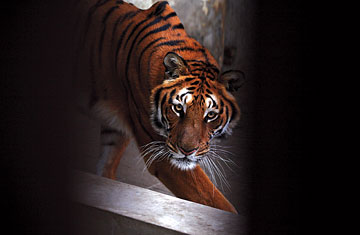
On the prowl
A South China tiger in his cage at the Suzhou South China Conservation Base
(7 of 8)
Taiwan defends itself vigorously. Ling Shiang-nung, vice chairman of the Council of Agriculture, questions both the sincerity and accuracy of international environmental groups that argue that tiger parts are still widely available. "We feel so disappointed that we are doing so much and getting so little credit for it," says Ling. Ginette Henley of TRAFFIC USA admits that the Taiwanese have taken steps but fears that Taiwan and China will do just enough to stave off sanctions and then allow the markets to resume business.
The issue will come to a head at this week's CITES meeting in Geneva, as delegates debate whether enough has been done in recent months to slow the tiger trade. Since cites has no enforcement powers of its own, only individual member nations can make the decision to impose trade sanctions. A key player to watch is the U.S., largely because of the strong stand taken by Interior Secretary Bruce Babbitt. An ardent environmentalist, he attended the Brussels meeting in September and played a major role in the effort to put pressure on China and Taiwan.
In particular, Babbitt announced a determination by the Clinton Administration that these countries were in violation of the so-called Pelly amendment, a once obscure section of the U.S. Fishermen's Protective Act that has the potential to become the world's most powerful piece of environmental legislation. It authorizes the use of trade sanctions against nations whose actions hurt endangered species. Just the threat of Pelly penalties a few years ago caused Japan to reduce the use of drift nets by its fishing boats and prompted Korea to join CITES.
This time the Clinton Administration in effect told China and Taiwan to clean up their act or face sanctions, and a March deadline was set. On the eve of the Geneva sessions, Babbitt remained firm. "All the CITES members will be taking signals from this meeting," said the Interior Secretary. "There may not be another chance to save the tiger."
According to Administration sources, the U.S. will encourage delegates to renew their September call to action. This would provide President Clinton with the diplomatic cover for imposing sanctions. Before he takes that step, though, Clinton advisers expect to encounter opposition from within the Administration, as concern for the tiger collides with a host of other issues that entangle the U.S., China and Taiwan.
For instance, having chosen not to impose sanctions on China for its persistent violations of human rights, ranging from its treatment of Tibet to the torture and imprisonment of political dissidents, the Administration may find it hard to explain why it is acting now because of environmental wrongs. And at a time when the U.S. is trying to lower trade barriers, some members of the Administration argue that punitive sanctions against China or Taiwan will send the wrong message about U.S. commitment to free trade. A State Department official suggests that it's too soon for the U.S. to play its last card. "Once you impose sanctions," he asks, "what do you do then?"