

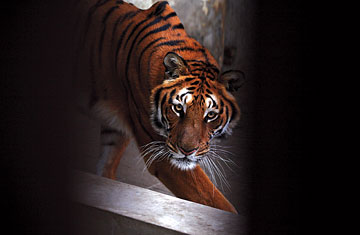
On the prowl
A South China tiger in his cage at the Suzhou South China Conservation Base
(6 of 8)
In 1989 the London-based Environmental Investigation Agency called on nations to impose sanctions against Taiwan for failing to halt illicit trade in endangered species. EIA investigators offered evidence of the open sale of tiger parts, including skins, and a host of other banned animal products. Since then, illegal wares have disappeared from display shelves, but subsequent investigations by several environmental groups suggest that potions made from tigers, rhinos and other endangered species are still readily available. As recently as this February, an undercover probe sponsored by Earth Trust in four Taiwanese cities found that 13 of 21 pharmacies visited offered tiger-bone medicines.
Renowned biologist George Schaller of New York's Wildlife Conservation Society warns that if the tiger-bone trade is allowed to continue, it will threaten all large cats. Traditional medicine makers also use bones from other endangered felines, such as the snow leopard and golden cat. "If the price keeps going up, the search for bone will start affecting cats in Africa," says Schaller.
The situation is almost a replay of the battle between environmentalists and Asian nations over the ivory trade, which led to rampant poaching of African elephants during the late 1980s. Fearful that the promises made about tiger parts were as empty as the ones made about ivory, 86 organizations, led by the Earth Island Institute (EIA) and Britain's Tiger Trust, took their case against China and Taiwan to the governing committee of CITES in March 1993. The committee gave the two countries six months to start cracking down on the trade in tiger parts and rhino horn. The deadline had little effect: at a meeting in Brussels last September, CITES declared the measures taken by China and Taiwan to be inadequate and set the stage for trade sanctions to be imposed.
Alarmed at that prospect, the two offending nations have since announced still more steps to curb the tiger-part trade, but they have yet to satisfy their critics. Chinese authorities say that they have assigned 40,000 people to enforce laws aimed at the black market and that more than 1,000 lbs. of confiscated tiger bone have been burned. Conservationists don't trust either claim. China has considered raising tigers in captivity to supply the traditional-medicine market, but that may only legitimize a nasty business. Poachers could pass off the tigers they kill as "captive bred."
The Taiwanese government has trumpeted the creation of a task force on endangered species within the national police. It remains unclear, however, whether the unit has been staffed or even has a budget. Taiwan officials have variously said the unit will have 300, 45 and six officers. So far, the Taiwanese have not made a single arrest, and response to a government call for people to come forward and register tiger parts and rhino horn has been embarrassingly small. Allan Thornton of the EIA says past efforts to enforce the law consisted of uniformed police asking pharmacies whether they had tiger bone -- something like having cops ask drug dealers whether they are carrying heroin.