

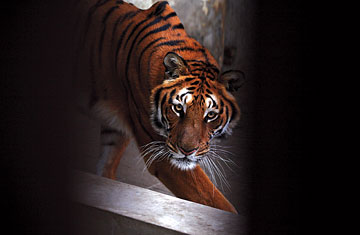
On the prowl
A South China tiger in his cage at the Suzhou South China Conservation Base
(3 of 8)
The forces driving the black market are so strong that nothing -- not public opinion, not political pressure, not the power of police -- has halted the tiger's slide toward extinction. Can international trade sanctions against Asian nations succeed where all else has failed? There is no guarantee. The tiger's plight reveals the limits of conservation efforts and raises disturbing questions about humanity's ability to share the planet with other animals. Says Elinor Constable, an Assistant Secretary of State who leads U.S. diplomatic efforts to help the tiger: "If the concerted efforts of the world cannot save the tiger, what will that say about our ability to deal with more complex environmental problems?"
Only a few years ago, the tiger was considered a conservation success story. Centuries of legal tiger hunting and forest destruction had raised the specter of extinction, but in 1972 governments rallied to rescue the cats. Taking up the issue as a personal cause, Indian Prime Minister Indira Gandhi launched Project Tiger, which established the country's network of reserves. Western nations joined with several Asian countries to ban hunting and the trade in skins. By 1980 populations on the subcontinent had recovered to the point where B.R. Koppikar, then director of Project Tiger, could boast to the New York Times, "You can say that there is now no danger of extinction of the tiger in India."
The conservation community so desperately wanted to believe in the success story that it ignored signs that all was not well. No government program could stop encroachment on tiger habitat as human numbers kept increasing; India alone has grown by 300 million people since the last tiger crisis. Moreover, many of the animals counted in Indian censuses turned out to exist only in the imaginations of bureaucrats who wanted to show their bosses that they were doing a good job of saving the tiger. Most significant, the tiger's defenders failed to pay enough attention to the growing market for its parts.
The market was always there, but in the 1980s it posed little threat to most tiger populations. In previous years China had slaughtered thousands of its tigers, claiming the animal was a pest that endangered humans. The massacre created a temporary glut of tiger bone -- more than enough to satisfy the traditional medicine market. Looking back on what happened next, Peter Jackson, chairman of the cat-specialist group at IUCN, the International Union for the Conservation of Nature, in Geneva, says ruefully, "We should have seen this coming." Only in the late 1980s, he notes, after the Chinese had exhausted their bone stockpiles, did conservationists begin to notice unusual trends in poaching.
Brijendra Singh, a member of India's Tiger Crisis Committee, recalls hearing the first reports in 1986 of poachers being apprehended with bags of tiger bones. Intrigued, Singh and other officials at Corbett National Park set out to exhume tiger carcasses that had been buried in previous years. The workers discovered that the skeletons had already been removed. Soon reports of poaching for tiger bones began to flood in from all over India.