

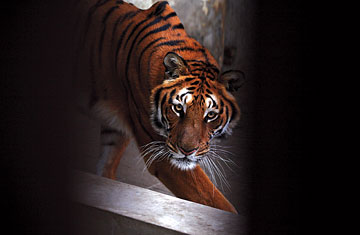
On the prowl
A South China tiger in his cage at the Suzhou South China Conservation Base
The great beast seems to materialize out of the dusk -- a striped vision of might and mystery. Emerging from a thicket in southern India's Nagarahole National Park, the Bengal tigress is hungry and ready to begin another night's hunt. To nourish her 500-lb. body, she must kill a sambar deer, a boar or some other big animal every week of her adult life. Fortunately for her, Nature has given tigers the prowess to prey upon creatures far larger than the cats are. Her massive shoulders and forelimbs can grip and bring down a gaur, a wild, oxlike animal that may weigh more than a ton. Her powerful jaws and daggerlike teeth can rip the victim's throat or sever its spinal column, making quick work of the kill. But there will be no killing at this moment. After padding along a park road for a mere 100 yds., the tigress abruptly melts into the brush -- here one instant, gone the next. Watching her disappear, Indian biologist Ullas Karanth of New York's Wildlife Conservation Society, breaks into a knowing smile. "When you see a tiger," he muses, "it is always like a dream."
All too soon, dreams may be the only place where tigers roam freely. Already the Nagarahole tigress is not free. If she hunts during the day, she may run into a carload of tourists, cameras clicking. At night, it may be poachers, guns blazing. Once the rulers of their forest home, she and the park's 50 other tigers are now prisoners of human intruders. More than 6,000 Indians live inside the 250-sq.-mi. refuge. And crowding the borders are 250 villages teeming with tens of thousands more people who covet not only the animals that the cats need for food but also the tigers. Their pelts and body parts fetch princely prices on the black market. Were it not for the 250 guards on patrol to protect Nagarahole's tigers, none of them would survive for long.
Sadly, this precarious life is as good as it gets for tigers today. Outside protected areas, Asia's giant cats are a vanishing breed, disappearing faster than any other large mammal with the possible exception of the rhinoceros. Even inside the parks, the tigers are succumbing to poaching and the relentless pressure of human population growth. No more than 5,000 to 7,500 of the majestic carnivores remain on the planet -- a population decline of roughly 95% in this century. Unless something dramatic is done to reverse the trend, tigers will be seen only in captivity, prowling in zoos or performing in circuses. The wild tigers of old will be gone forever, their glory surviving merely in storybooks, on film -- and in dreams.
Preventing such a tragedy is supposed to be the main goal of the governing body of CITES, the Convention on International Trade in Endangered Species, which is meeting in Geneva this week. These biannual sessions usually come and go without attracting much attention, but the plight of the tiger has put a spotlight on the delegates this time around. Last September cites warned China and Taiwan, two countries where the illicit trade in tiger and rhino parts is prevalent, to take steps to shut down their black markets or face possible trade sanctions. Both nations claim to have curbed the illegal commerce, but environmentalists have gathered evidence to the contrary. Now everyone who is worried about wildlife focuses on one question: Will the nations of CITES follow through on their threat against China and Taiwan?