

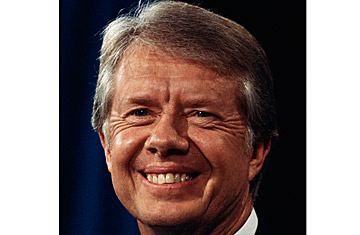
39th President of the United States Jimmy Carter
(6 of 6)
More money than ever was spent on television, and since the candidates' appearance on TV was a decisive factor, more political amateurs were encouraged to run. The new U.S. Senate has a large freshman class of 19, and seven of those have never before held any elective office. The concentration on television had the additional effect of drying up much traditional grass-roots activity and limiting get-out-the-vote efforts on Election Day. "Maybe some innovative candidate will dream up grass roots again," says Judy Baker, a Democratic activist in Fairfield, Calif. Indeed one has. Victor Atiyeh, Republican candidate for Governor of Oregon, proved that the old methods can still work their wonders. Considered an underdog in his race against Democratic Governor Bob Straub, he avoided television, logged 40,000 miles in a door-to-door campaign and won an upset victory.
Trying to assert their individuality and freedom from party ties, candidates resorted to a variety of gimmicks. For some of them, running for office meant literally that. Massachusetts Governor-elect Edward King ran several miles every day at dawn. Paul Tsongas had squads of campaign workers running for him; then, in red shorts, he joined them for the last two-mile lap to Faneuil Hall for the windup of the campaign. To show he is perfectly fit at 76, Strom Thurmond kept sliding down a pole in a firehouse in South Carolina. For the most part the carelessly tousled John F. Kennedy look was out; more formality was in. Frank Collazo Jr., who worked for 20 years in the oil refineries around Port Arthur, Texas, wore jeans when he successfully ran for the state's house of representatives two years ago. This year he donned pinstripe suits and conservative ties in his uncontested reelection campaign.
For all the new freedom of maneuvering, certain rules still applied. Though there were countless personal attacks in an election that lacked major issues, dirty tricks seemed to be at a minimum. In a radio ad, Democrat Alex Seith tried to associate his opponent, Charles Percy, with a scurrilous joke that former Agriculture Secretary Earl Butz once told about blacks; even members of Seith's own party told him he had gone too far. When Democratic Senator Hathaway tried to portray his opponent, Bill Cohen, as a contrivance of the media, the Republican responded with a TV ad showing his own slick self being splattered with mud by his opponent. The commercial is credited with giving Cohen a final boost to victory. Beneath all the showmanship, the confusing verbiage, the mounds of money, voters in their own instinctive way managed to discern the more creditable candidates. In all their variety, the freshly elected officeholders are undoubtedly an accurate reflection of the current American mood.