

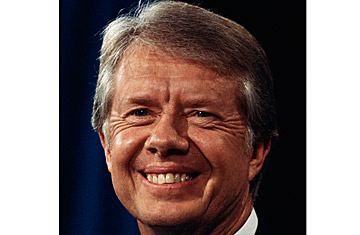
39th President of the United States Jimmy Carter
(5 of 6)
Some of the most prominent over-promisers went down to resounding defeat. In the New Jersey Senate race, Jeff Bell, perhaps the most avid proponent of Kemp-Roth, was beaten by former Basketball Star Bill Bradley, who proposed more modest tax cuts. Perry Duryea, the G.O.P. candidate for Governor of New York, promised to increase welfare grants and reduce taxes at the same time. The victorious incumbent, Hugh Carey, refrained from any such foolishness. In Arkansas, Bill Clinton, 32, was elected the nation's youngest Governor, even though he vowed to ask for a tax increase if a referendum reducing the state sales levy on food and drugs was approved. It was not.
Though 80% of the referendums imposing limits on taxes and spending in 16 states were approved by the voters, two that were modeled after California's celebrated Proposition 13 were rejected. In Michigan, voters said yes to a measure limiting state spending to the increase in state personal income, but they turned down a proposal to roll back property taxes roughly 50%. Moderation, even in tax cutting, seemed to be the voters' message. After surveying the results, Bill Brock started backing away from Kemp-Roth. As an alternative, he proposed "son of Kemp-Roth," a scheme devised by Democratic Senator Sam Nunn to tie tax reductions to cuts in spending.
The election marked the further erosion of the two-party system. Ticket splitting was rampant. Unpredictable, independent-minded voters gave Republican Milliken a third term in the Michigan statehouse but ejected G.O.P. Senator Robert Griffin. In Kansas, Republican Governor Robert Bennett was ousted by Democrat John Carlin, but Republican Nancy Kassebaum coasted to an easy victory over her Democratic opponent, Bill Roy, and thus became the only woman to serve in the Senate at the present time.
In general, candidates seemed to win on the basis of local issues and services they had or had not provided. For all the talk of an anti-incumbent year, not too many were turned out of office. Most Representatives who left Congress quit of their own accord. Of 377 incumbents running for re-election to the House, only 19 lost their seats.
Much more than before, candidates were financed from nonparty sources. Under the revised campaign finance law, a candidate can spend as much as he wants of his own money. Not surprisingly, a lot of millionaires ran for office, and most of them won. Otherwise, funds were supplied in abundance by the political action committees (PACS) that have proliferated under the campaign finance law. Formed by business, labor and a host of other special interest groups, PACs had contributed more than $60 million at the mid-point of the campaign, as compared with spending a total of $23 million in the last presidential election. There were some signs of a backlash against the growing influence of the PACs. Wisconsin Governor-elect Dreyfus singled them out for special obloquy in his rambunctious quasipopulist campaign against the special interests.