

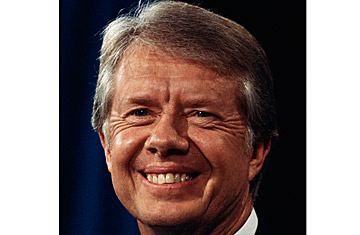
39th President of the United States Jimmy Carter
(3 of 6)
Vice President Walter Mondale suffered a stunning slap in the face in his native state of Minnesota, which has long been considered a liberal stronghold. There, amid the fractious squabbling of the Democratic-Farmer-Labor Party, the G.O.P. scored a major sweep. Despite numerous visits and pep talks by Mondale, despite two trips to the state by the President, the voters turned the Democrats out of the governorship and both Senate seats. In a rueful postmortem, a shellshocked Mondale concluded: "I shouldn't have told them to do it for Hubert Humphrey and me, but to do it for themselves."
Presidents are rarely the central issue in off-year elections, and Carter was no exception. He admitted at his televised press conference last week: "I doubt my presence had much of an impact on the outcome of those who won. I don't look on it as a referendum on whether I have done a good job or not." Until his success at Camp David, Carter was generally considered a liability, and there was little demand for his help in campaigns. In the 31 states he has visited, he turned out crowds, aroused some excitement and drummed up publicity for the candidates. But an ABC News/Harris analysis of 104 swing districts indicated that the President had no measurable influence in the districts he visited. But then neither did Ted Kennedy, Ronald Reagan or Gerald Ford. Coattails, which never mean too much in an off year, seemed especially threadbare.
Carter's problems with Congress will undoubtedly be increased by the rightward shift among the incoming legislators. Again, the numbers are less important than the individual changes. The President lost five key liberal supporters in the Senate: Clark of Iowa, Thomas Mclntyre of New Hampshire, William Hathaway of Maine, Floyd Haskell of Colorado, Wendell Anderson of Minnesota. As head of the African Affairs Subcommittee, Clark was a strong backer of the Administration's policy of pressuring the white powers in southern Africa to grant black majority rule. He was defeated by Conservative
Republican Roger Jepsen, who made a campaign issue of his opponent's foreign policy. Senator Mclntyre, a member of the Armed Services Committee and a provisional supporter of SALT II, will be replaced by former Airline Co-Pilot Gordon Humphrey, who opposes SALT and says he plans to be the "biggest skinflint" in Washington. Haskell and Hathaway were two of the most liberal members of the Senate Finance Committee. A few mainstream liberals were elected to the Senate: Bill Bradley in New Jersey, Paul Tsongas in Massachusetts, Carl Levin in Michigan, Donald Stewart in Alabama. But they do not have the experience or the seniority to replace the members who were defeated.