

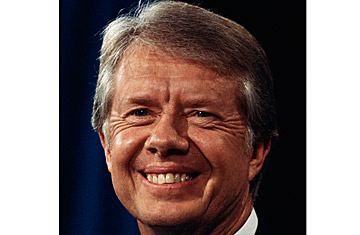
39th President of the United States Jimmy Carter
The desperate last-minute appeal somehow symbolized the whole tumultuous campaign year. There, in a 30-second television commercial, was the usually dapper and composed Senator Charles Percy of Illinois looking haggard and close to tears. Staring straight into the camera, the onetime presidential aspirant implored millions of unseen viewers: "I got your message and you're right. Washington has gone overboard, and I'm sure that I've made my share of mistakes, but your priorities are mine too. Stop the waste. Cut the spending. Cut the tax."
The voters got Percy's message too. He was saved from the brink of defeat and returned to the Senate. He had belatedly discovered what most candidates had learned much earlier in the campaign. If they wanted to get elected, they had better propose some kind of cut in taxes or spending or both. The American people had soured on costly government and demanded relief —now. That was, as much as any, the message of last week's off-year elections.
It was not, however, an easy election to decipher. Gone were the sharp, divisive ideological issues that had enlivened and embittered previous campaigns. Foreign or defense policies, for example, were seldom brought up. If there was a national consensus to do something to resist high taxes, spending and inflation, that could be called, in traditional terms, conservative. But the voters' antigovernment mood appeared more cautious than many prophets had predicted. The mood instead seemed quirky, dissatisfied, independent. While some notable liberals like Senator Dick Clark of Iowa were defeated, so were some right-wingers like Governor Meldrim Thomson of New Hampshire, and in a few states, like Massachusetts, people voted for both sides at once. Worries about widespread apathy also seemed to be exaggerated, though people turned out to vote in somewhat smaller numbers than usual (see chart page 35).
While there were many individual changes, last week's voting did not substantially alter the political lineup. The party in power usually suffers some reverses in off-year elections. But the Democrats, moving quickly and adroitly to exploit popular dissatisfaction with their own economic policies, kept losses to a minimum and remained in solid control of both houses of Congress. They stayed in command of 32 statehouses and both houses of at least 29 state legislatures. But the Republicans scored significant gains, showing that the endangered par ty can still make a comeback. When G.O.P. National Chairman Bill Brock was jokingly asked if the U.S. political system could be described as "a party and a quarters." half," he Brock replied, added: "It's "We one will and go three-into 1980 stronger than we were in 1976."