

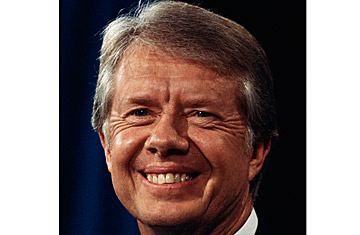
39th President of the United States Jimmy Carter
(2 of 6)
The G.O.P. achieved a net gain of three Senate seats, giving it 41 members to the Democrats' 59. In the House, the Republicans picked up twelve seats for a total of 159; the Democrats have 276. The Republicans did even better in state government. They won six additional governorships, giving them 18 out of the 50. Perhaps even more important, they gained 298 seats in the state legislatures, far more than the 200 they expected to win. They now have 2,699 seats out of a total 7,562. They achieved a majority in 13 additional chambers and increased from four to twelve the number of states where they control both houses. "This is the most profound change for us," said Brock. He was relieved because state legislatures will redistrict after the 1980 census. If the Republicans had not made considerable gains, they might have been gerrymandered to near oblivion. In 1976, it is estimated, the Republicans won 42% of the total congressional vote but captured only 33% of the seats in the House. Now Republicans figure that they are at the mercy of redistricting Democrats in only 20 states.
The Democrats, despite their many victories, were not pleased with the results. On election night, Jimmy Carter's White House aides cheerfully closeted themselves in Press Secretary Jody Powell's cluttered office to watch the returns. By midnight, their mood had changed. When Democratic National Committee Chairman
John White emerged, he looked harassed and talked dully. Hamilton Jordan slammed a door against TV cameras. The normally chatty Jerry Rafshoon had nothing to say. Political Coordinator Tim Kraft looked in need of an Alka-Seltzer. The President, who had been privately watching the returns with Rosalynn, did not even appear. At a press conference in Kansas City two days later, he remarked laconically: "I think the Democrats did fairly well on a nationwide basis. But we lost some very key races."
For the President, the numbers of party victories were less troubling than the particular winners and losers. Potentially strong Republicans had captured key governorships: Richard Thornburgh in Pennsylvania, William Clements in Texas, Lee Dreyfus in Wisconsin. Republican Jim Rhodes remained in control of the Ohio statehouse, and Bill Milliken was re-elected Governor of Michigan. Perhaps most threatening of all, Jim Thompson won re-election in Illinois by 600,000 votes-demonstrating that he is a moderate Republican with broad appeal in a big industrial state. He has not denied that he might run for President in 1980. Said Thompson: "The Republican Party has come alive again in its traditional seat of power, in the Midwest where it was born."
Nor could Carter take pleasure in all of his own party's winners. California Governor Jerry Brown, who defeated Carter in three primaries in 1976, was re-elected by a whopping 1.3 million votes, though the turnout was modest. The landslide gave him a strong boost toward a 1980 presidential bid.