

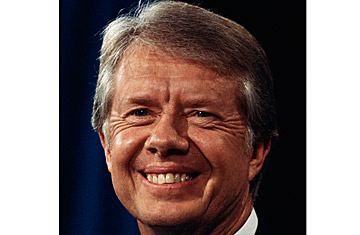
39th President of the United States Jimmy Carter
(4 of 6)
The conservative Republicans, on the other hand, have been strengthened in Congress, especially in the Senate. Some new right-wingers (Mississippi's Thad Cochran, Colorado's Bill Armstrong, Jepsen and Humphrey) have swelled the ranks of the old (North Carolina's Jesse Helms, Idaho's James McClure, Texas' John Tower and South Carolina's Strom Thurmond). With the defeat of Edward Brooke in Massachusetts, the Senate's only black, the waning power of the liberal Republicans has been reduced even further. Their only gain is Bill Cohen, who was elected in Maine. Led by Nevada's Paul Laxalt, the conservatives have become a formidable force in the Senate, one capable of blocking key Carter initiatives.
In the 95th Congress, Carter was able to count on the occasional, indispensable services of Minority Leader Howard Baker. Without Baker, the Panama Canal treaties would not have been ratified, the Turkish arms embargo lifted or the three-way Middle East weapons sale approved. But Baker may no longer be able to come to the aid of the President. No sooner were the election results apparent than conservative Republicans started plotting to take over at least some of the leadership positions in the Senate, including a challenge by Helms for on-floor leadership. Taking no chances, Baker dashed back to Washington to phone other victorious Republicans and ask for their support to continue as minority leader. He claims that he lined up 33 votes, far more than the 20 he needs to keep his post. But to maintain his leadership, he will undoubtedly be maneuvered to the right. "It's a new ball game," says a moderate Republican Senator. "It doesn't take much to change things around."
If the President chooses to concentrate on thrift and budget cutting during the second half of his term, he may have only minimal difficulties on Capitol Hill, and it could be argued that the disappearance of both liberals and some conservatives has put the Democrats more in line with Carter's personal position. But if Carter tries to push new spending programs or controversial foreign and defense policies, he is bound to face more flak from the 96th Congress than he did from the disruptive 95th. That applies particularly to the Strategic Arms Limitation treaty, for even Senate Majority Leader Robert Byrd has misgivings about the pact.
The G.O.P. gains would probably have been greater if the party had exploited the economic issue more skillfully. A Republican issue of long standing, it was simply appropriated by the Democrats. "The Republicans set the agenda for the campaign," says Political Consultant Mark Shields. "The Democrats dominated the dialogue." Many Republicans campaigned on the Kemp-Roth plan to cut federal income taxes by 33% over three years; the measure is based on the theory that a sharp tax reduction would generate enough business activity to make up for the lower rates. Even though voters want tax reductions, they were skeptical of a scheme that sounded so much like a free lunch.